Try Tidyflow
Get your firm organized.
Watch a 4-minute demo, or start a free trial. No credit card required.
Timesheets are the default in accounting firms. But a growing number of firms are dropping them entirely — and running more profitably because of it. This guide covers why timesheets are problematic, what to replace them with, and how to make the transition step by step.
Why Firms Are Ditching Timesheets
They Punish Efficiency
Under hourly billing, the faster you work, the less you earn. A senior accountant who completes a tax return in 3 hours bills less than a junior who takes 8 hours on the same return — even though the senior’s work is better and delivered faster.
This creates a perverse incentive: work slowly, bill more. That’s the opposite of how a profitable firm should operate.
They Measure the Wrong Thing
Timesheets measure hours worked, not value delivered. A firm owner looking at timesheets can tell you that Sarah worked 42 hours last week. They can’t tell you whether those 42 hours produced $10,000 or $100,000 in value for clients.
They’re Inaccurate
Studies consistently show that timesheets are filled in late, estimated rather than tracked in real time, and inflated or deflated depending on the situation. A tool that’s routinely inaccurate isn’t a tool — it’s a ritual.
They Damage Morale
Tracking every 6-minute increment creates anxiety and micromanagement. Accountants who should be focused on solving client problems are instead worried about whether they’ve logged enough billable hours.
They Create Adversarial Client Relationships
Clients hate hourly billing. Every conversation, every email, every question comes with an implicit question: “Am I being billed for this?” That kills the trust and openness that good advisory relationships need.
What Replaces Timesheets?
Dropping timesheets doesn’t mean you stop tracking profitability. It means you change what you measure and how you price.
Fixed-Fee Packages
Price your services as defined packages with clear scope:
Example packages:
| Package | What’s Included | Monthly Price |
|---|---|---|
| Bookkeeping Basic | Monthly bookkeeping (up to 50 txns), bank rec, P&L report | $400–600 |
| Bookkeeping + Tax | Above + annual tax return + BAS/GST lodgement | $600–1,000 |
| Full Service | Bookkeeping + tax + payroll + quarterly advisory call | $1,200–2,000 |
| Advisory | Monthly financial review, KPI tracking, tax planning, unlimited support | $2,000–5,000 |
Clients choose the package that fits their needs. You know exactly what you’re delivering. Billing is predictable for both sides.
For detailed package examples and benchmarks, see our guide on pricing accounting services.
Value-Based Pricing (For Advisory)
For advisory and strategic work, price based on the value you create:
- Tax strategy that saves $30,000/year → price at $3,000–5,000
- Entity restructuring that saves $15,000/year in taxes → price at $2,000–4,000
- Cash flow forecasting that prevents a $50,000 cash shortfall → price at $3,000–5,000
The key is communicating the value before you deliver the service: “Here’s what this will likely save you, and here’s what it costs.”
Subscription Model
Some firms offer an all-inclusive monthly subscription where clients pay a flat fee for access to all services. Think of it like a retainer but with a defined service menu.
This works well for clients who value simplicity and for firms that want maximum revenue predictability.
How to Make the Transition
Step 1: Analyze Your Current Profitability
Before dropping timesheets, understand which clients and services are profitable under your current model:
- Which clients generate the most revenue per hour of work?
- Which services have the best margins?
- Which clients consistently take more time than you bill for?
This analysis tells you where your current pricing is working and where it’s failing — information you need to set fixed fees accurately.
Step 2: Build Your Service Packages
Based on your profitability analysis:
- List every service you deliver (bookkeeping, tax, BAS, payroll, advisory, etc.)
- Group them into logical tiers (basic, standard, premium)
- Estimate the average time each tier takes to deliver per client per month — not for billing, but for capacity planning
- Set prices that cover your costs with a healthy margin (target 60–70% gross margin)
Step 3: Transition Existing Clients
Don’t switch every client overnight. Start with:
- New clients → all new clients go on fixed-fee packages immediately
- Existing clients (straightforward) → convert at the next billing cycle. Most won’t notice a change if the total annual cost is similar.
- Existing clients (complex) → have a conversation. Explain the benefits: “You’ll know exactly what you’re paying every month, no surprises.”
Some clients will resist, especially those who are currently underpaying relative to the work involved. That’s a pricing correction, not a problem.
Step 4: Replace Time Tracking with Job Tracking
You’re not tracking hours anymore — but you still need visibility into workload and profitability. Track:
- Jobs — what work is in progress, what’s completed, what’s overdue
- Job status — not started, in progress, waiting on client, in review, complete
- Team workload — who has too much work, who has capacity
- Client profitability — revenue per client vs cost to serve (estimated, not tracked to the minute)
This is capacity planning rather than time tracking. You’re looking forward (can we handle the work coming up?) instead of backward (how many hours did we work last week?).
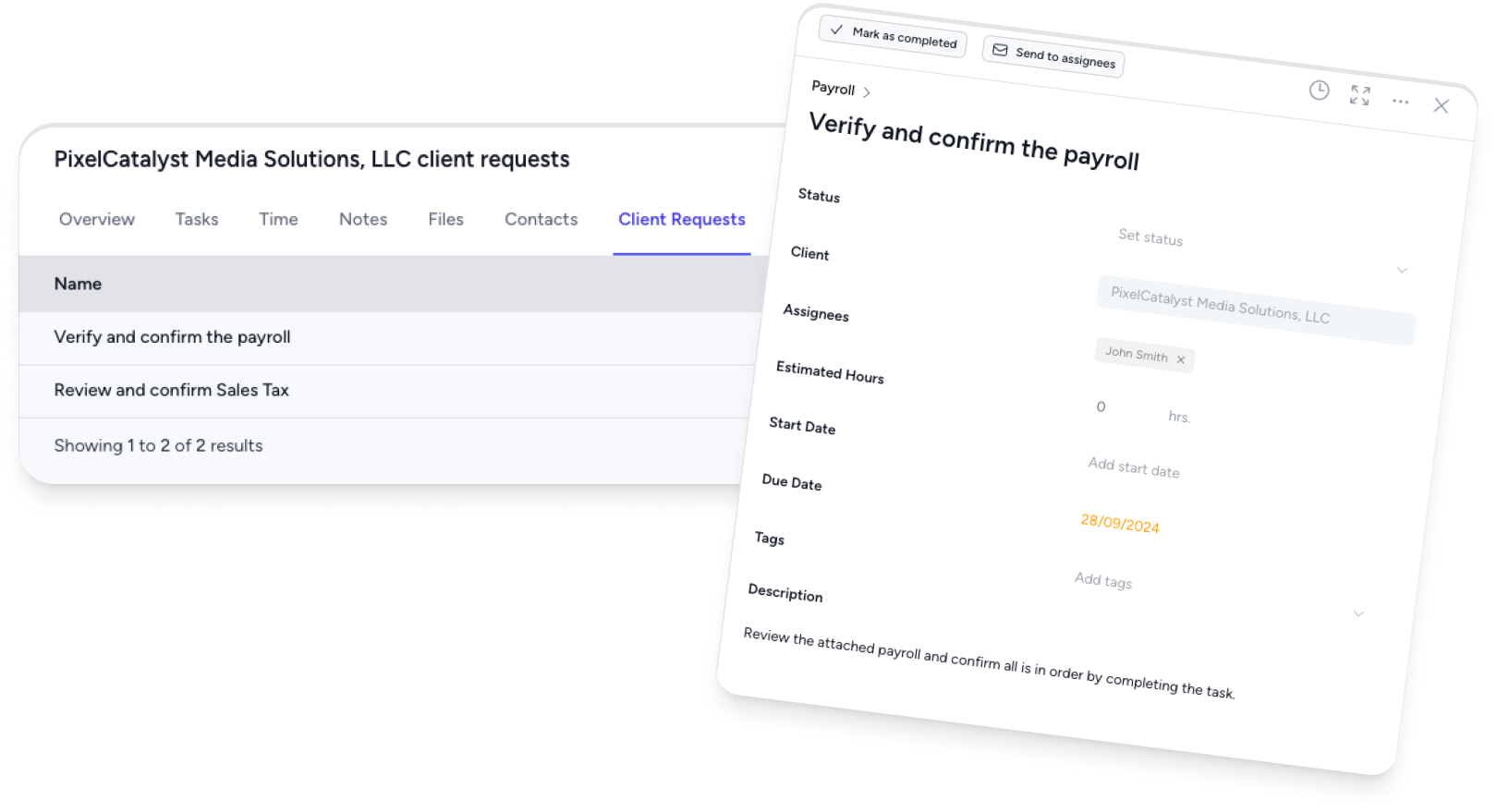
Tidyflow supports this approach with job management and capacity planning built in. You manage work through job statuses and team capacity views rather than timesheets. Each job has estimated hours for capacity planning, but billing is based on your fixed-fee packages — not time logged.
Step 5: Communicate the Change to Your Team
Your team needs to understand:
- What’s changing: We’re pricing based on value and packages, not hours
- What’s NOT changing: We still care about efficiency and quality
- How they’ll be measured: By job completion, quality, client satisfaction, and meeting deadlines — not by billable hours logged
- What this means for them: Less admin (no more timesheets), more focus on doing great work
The biggest mindset shift is for people who’ve spent years equating “billable hours” with “productivity.” Help them understand that completing 5 tax returns in a week is more productive than spending 40 hours on 3.
Step 6: Monitor and Adjust
After the transition, watch for:
- Services that consistently take longer than estimated → you’ve underpriced them. Adjust the fee or tighten the scope.
- Clients who are significantly more work than similar clients → they may need a higher tier or a scope conversation.
- Team members who are consistently overloaded → your capacity planning needs adjustment.
Review monthly for the first 6 months, then quarterly.
Do You Still Need Any Time Tracking?
Some firms go completely time-free. Others keep lightweight time tracking for internal purposes — not for billing, but for:
- Verifying pricing accuracy: If a $600/month client consistently takes 12 hours to serve and a similar client takes 4 hours, you have a pricing or efficiency problem.
- Capacity planning: Knowing roughly how long job types take helps you plan workload.
- Identifying inefficiencies: If year-end accounts take 15 hours for one team member and 8 for another, that’s a training opportunity.
The key distinction: time tracking is an internal management tool, not a billing mechanism. Clients never see it. It’s optional, lightweight, and used for business intelligence — not for generating invoices.
Tidyflow includes optional time tracking alongside its job management — so you can track time for internal analysis without tying it to client billing. It’s there if you want it, invisible if you don’t.
What Firms Get Wrong
Dropping timesheets without changing pricing. If you stop tracking time but keep billing hourly (just estimating instead of tracking), you haven’t solved anything. You’ve made billing less accurate without changing the model.
Not adjusting prices for unprofitable clients. The transition is a perfect opportunity to fix underpriced clients. If a client has been getting $2,000/month of work for $800/month, moving to a $1,500 fixed fee is an improvement for you and still a good deal for them.
Expecting zero pushback. Some clients will question the change. Most will come around when they understand the benefits (predictability, no surprise bills, focus on outcomes). A few may leave — and those are often the least profitable clients anyway.
The Bottom Line
Running a firm without timesheets isn’t radical — it’s increasingly the norm for modern accounting practices. The firms doing it well are more profitable, have happier teams, and build stronger client relationships.
The transition requires planning, but it’s not complicated: package your services, set fair prices, track jobs instead of hours, and manage capacity forward instead of looking backward.
Start with new clients on fixed-fee packages. Convert existing clients over 6–12 months. Within a year, you’ll wonder why you ever bothered with timesheets.