Try Tidyflow
Get your firm organized.
Watch a 4-minute demo, or start a free trial. No credit card required.
Pricing bookkeeping services is the question every bookkeeper agonizes over. Charge too little and you’re working long hours for thin margins. Charge too much without communicating value and prospects go elsewhere. Most bookkeepers end up undercharging because they don’t know what the market will bear.
This guide gives you real pricing benchmarks, package examples, and a framework for setting profitable prices.
How Much Do Bookkeepers Charge?
Bookkeeping is priced three ways — hourly, per month, or per transaction — and most established bookkeepers settle on a fixed monthly fee. As a quick benchmark for the US and similar markets:
- Hourly rates run $25–$100/hour: roughly $25–45 entry level, $40–75 for experienced bookkeepers, and $60–100 for specialists.
- Monthly bookkeeping fees range from about $200–$500/month for a sole trader up to $1,500–$3,000+/month for a mid-size business, based on transaction volume and scope.
- Cleanup / catch-up work is usually billed hourly at $75–$150/hour.
The rest of this guide breaks these down by client size, shows example packages with real dollar amounts, and gives you a framework for setting your own profitable prices.
Pricing Models
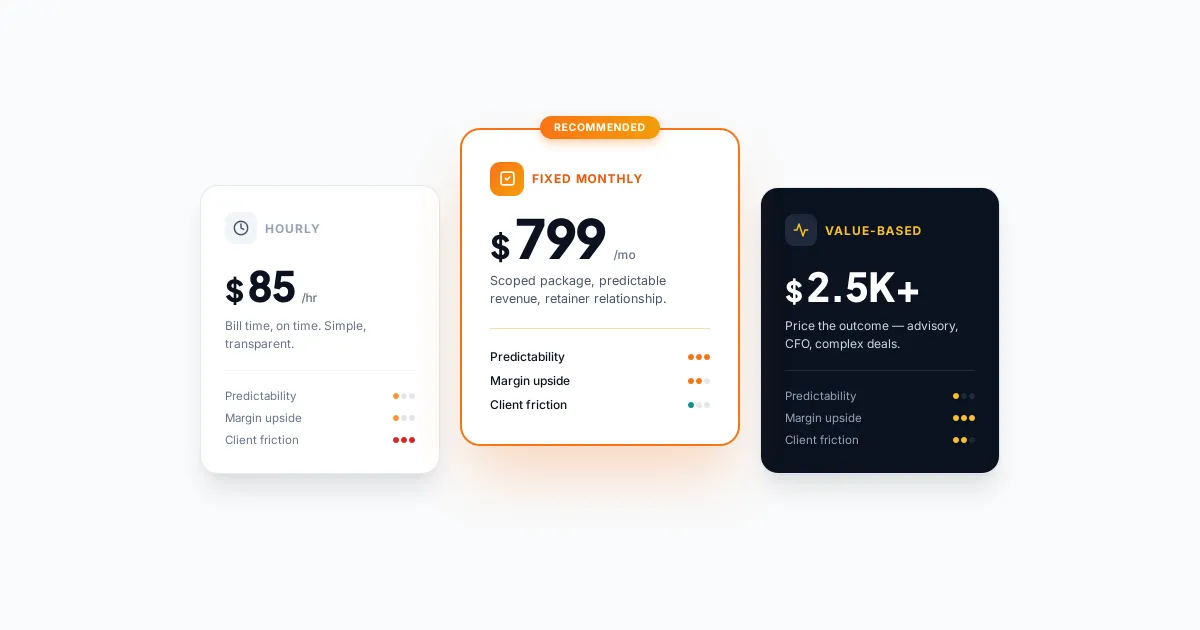
Fixed Monthly Fee (Recommended)
Charge a set price per month based on the client’s complexity and transaction volume.
Pros: Clients love predictability. You’re rewarded for efficiency. Revenue is recurring and plannable.
Cons: Risk of scope creep if boundaries aren’t clear. Requires good upfront estimation.
Hourly Rate
Charge per hour worked. Simple to calculate.
Typical rates:
- Entry-level bookkeeper: $25–45/hour
- Experienced bookkeeper: $40–75/hour
- Bookkeeper with specialized expertise: $60–100/hour
Pros: Simple to implement. Fair for highly variable or one-off work.
Cons: Penalizes efficiency. Clients dislike unpredictable bills. Caps your revenue since you’re selling time.
Per-Transaction Pricing
Charge per transaction processed (e.g., $1–3 per transaction).
Pros: Scales directly with workload. Easy for clients to understand.
Cons: Revenue fluctuates monthly. Clients with declining transactions pay less even though your fixed costs don’t change.
Recommendation: Use fixed monthly fees for recurring clients. Use hourly rates for one-off work like cleanup bookkeeping.
Real Pricing Benchmarks
These are typical ranges for US and Australian markets. Adjust for your location.
Monthly Bookkeeping
| Client Type | Transactions/Month | Accounts | Monthly Price |
|---|---|---|---|
| Sole trader / freelancer | Under 30 | 1–2 | $200–350 |
| Sole trader (active) | 30–75 | 2–3 | $300–500 |
| Small business (1–5 employees) | 75–150 | 3–5 | $500–900 |
| Growing business (5–20 employees) | 150–300 | 5–8 | $800–1,500 |
| Mid-size business (20+ employees) | 300–500+ | 8+ | $1,500–3,000+ |
Payroll (Add-On)
| Employees | Monthly Price |
|---|---|
| 1–5 | $100–200 |
| 5–15 | $200–400 |
| 15–30 | $400–700 |
| 30+ | $700+ |
BAS/GST/Sales Tax (Add-On)
| Frequency | Price |
|---|---|
| Quarterly BAS | $100–250/quarter |
| Monthly BAS | $75–200/month |
Cleanup / Catch-Up Bookkeeping
| Complexity | Hourly Rate |
|---|---|
| Simple (few months behind) | $75–100/hour |
| Complex (1+ year behind, messy records) | $100–150/hour |
Estimate the total hours upfront and quote a fixed project fee when possible. “Your cleanup will be $1,200” is better than “it’ll be $100/hour and I’m not sure how long it’ll take.”
Example Packages
Starter — $300–500/month
For: Sole traders and freelancers with simple needs.
- Monthly bookkeeping (up to 50 transactions)
- Bank reconciliation (1–2 accounts)
- Monthly P&L report
- Email support (2 business day response)
Standard — $600–1,000/month
For: Small businesses with 1–10 employees.
- Monthly bookkeeping (up to 150 transactions)
- Bank and credit card reconciliation (up to 5 accounts)
- Monthly P&L, balance sheet, and cash flow statement
- Accounts receivable tracking
- BAS/GST preparation and lodgement (quarterly)
- Email support (same business day response)
Premium — $1,200–2,000/month
For: Growing businesses that need more hands-on support.
- Everything in Standard with higher transaction limits
- Payroll processing (up to 15 employees)
- Monthly BAS/GST
- Bill payment management
- Monthly 30-minute review call
- Priority support
How to Calculate Your Price
A bookkeeping pricing calculator does not need to be complicated. Start with the cost of delivering the work, then adjust for scope and the margin the firm needs.
Monthly price = (delivery hours × fully loaded hourly cost + direct software costs) ÷ (1 − target gross margin)
Use the same inputs for every prospect:
| Input | What to include |
|---|---|
| Delivery hours | Reconciliation, coding, review, reporting, meetings and expected support |
| Fully loaded hourly cost | Salary or owner target income, payroll costs and overhead divided by realistic productive hours |
| Direct costs | Client-specific apps, payment costs or outsourced processing |
| Gross-margin target | The margin required to fund non-client work, mistakes, growth and profit |
| Complexity allowance | Extra entities, accounts, currencies, payroll, sales tax, cleanup or urgent deadlines |
Step 1: Know Your Costs
Your cost per hour = (Annual salary/target income + Overhead) ÷ Billable hours per year
Example: $80,000 target income + $15,000 overhead = $95,000. At 1,400 productive hours/year = $68/hour cost.
Step 2: Estimate Time Per Client
- Simple sole trader (30 transactions/month): ~2 hours/month
- Small business (100 transactions): ~5 hours/month
- Growing business (250 transactions): ~10 hours/month
Step 3: Apply Your Margin
Target 50–70% gross margin. If a client takes 5 hours at $68/hour cost ($340), the formula produces:
- 50% margin: $340 ÷ 0.50 = $680/month
- 60% margin: $340 ÷ 0.40 = $850/month
- 70% margin: $340 ÷ 0.30 = $1,133/month
Then add any direct software cost and a clearly defined complexity allowance. Do not quietly pad the estimate: show the client which scope factors move them into a different package.
Step 4: Check the Market
Compare to the benchmarks above. If your price is wildly above or below the range, investigate — you may be underestimating time, overpricing, or in a market with different cost dynamics.
How to Communicate Pricing to Prospects
Don’t Lead With Price
Lead with what the client gets, then state the price:
“We’ll handle your bookkeeping end-to-end — bank reconciliation, categorization, and a clean P&L and balance sheet delivered by the 15th of each month. You won’t need to worry about staying on top of your books. The investment for this is $600 per month.”
Use Anchoring
Present your premium package first. When a prospect sees the $2,000/month Premium option first, the $600/month Standard package feels affordable by comparison.
Qualify Before Quoting
Ask these questions before giving a price:
- What accounting software do you use?
- Roughly how many transactions per month?
- How many bank and credit card accounts?
- Do you have employees (payroll)?
- Are your books currently up to date or do they need cleanup?
The answers determine which package fits and whether cleanup work is needed first.
When to Raise Prices
Annually at minimum. Even if nothing else changes, inflation justifies 3–5% annual increases.
When a client’s complexity grows. If they started with 50 transactions and now have 200, they’ve outgrown their package.
When you’re fully booked. If you’re turning away clients, your prices are too low.
For fee increase templates and scripts, see our accounting fee increase guide.
Common Pricing Mistakes
Pricing based on what you’d pay, not what the service is worth. You’re not your target client. A business owner happy to pay $700/month for someone to handle their books sees it differently than you do.
Not including scope limits. “Monthly bookkeeping” without transaction limits means a client with 500 transactions pays the same as one with 30. Always specify limits.
Competing on price. The cheapest bookkeeper in town is also the busiest, most stressed, and least profitable. Compete on quality, reliability, and communication instead.
Quoting too fast. Take time to assess the client’s needs before giving a number. A quick quote based on incomplete information leads to underpricing.
Frequently Asked Questions
How much do bookkeepers charge per hour?
Hourly bookkeeping rates typically run $25–$100/hour depending on experience — roughly $25–45 for entry level, $40–75 for experienced bookkeepers, and $60–100 for specialists. Cleanup and catch-up work is usually billed at $75–150/hour.
What is the average monthly bookkeeping fee?
Monthly bookkeeping fees usually range from $200–500/month for a sole trader or freelancer, $500–900/month for a small business with a few employees, and $1,500–3,000+/month for a mid-size business. The fee depends on transaction volume, number of accounts, and whether payroll and sales tax are included.
How much should I charge for bookkeeping services?
Start from your cost per hour, estimate the time each client takes, and apply a 50–70% gross margin, then sanity-check against market benchmarks. For recurring clients, a fixed monthly fee based on transaction volume and scope beats hourly billing.
Is hourly or fixed-fee pricing better for bookkeeping?
Fixed monthly fees are better for recurring bookkeeping because they are predictable for the client and reward you for being efficient. Reserve hourly billing for one-off or unpredictable work like cleanup and catch-up projects.
How does a bookkeeping pricing calculator work?
Estimate the monthly delivery hours, multiply them by your fully loaded hourly cost, add software or pass-through costs, then divide by one minus your target gross margin. Add a complexity allowance for extra accounts, payroll, sales tax, poor records or faster reporting deadlines.
Tools That Support Your Pricing
Tidyflow helps firms put fixed-fee pricing into practice. Set up recurring invoices that match your service packages, track time internally to verify pricing accuracy, and use job templates to standardize delivery across clients.
Combined with the client portal and automated requests, the same system connects document collection, recurring work, delivery and payment rather than leaving each step in a separate tool.