Try Tidyflow
Get your firm organized.
Watch a 4-minute demo, or start a free trial. No credit card required.
The best ChatGPT prompts for accountants are specific, contextual, and explicit about the output you need. They can speed up first drafts of client emails, financial commentary, research plans, SOPs, and marketing content, but every result still needs professional review.
Below are 55 copy-paste prompts organized around common accounting-firm workflows. Replace the bracketed details, remove anything confidential, and adjust the instructions to match your firm and jurisdiction.
Important: Never paste client-identifiable or confidential information (including names, tax IDs, bank details, payroll data, or unredacted financial statements) into a public AI tool. Use anonymized inputs and only firm-approved tools with appropriate privacy controls. Verify every financial, tax, regulatory, and client-facing output before using it. If your firm doesn’t have written rules for this yet, our AI policy template for accounting firms is a ready starting point.
Get all 55 prompts as a printable PDF
Drop your email and we'll send the full prompt pack, organized by category and ready to paste. No spam.
No spam. Unsubscribe anytime. See our privacy policy.
Check your inbox
We've sent the template to your email. If it doesn't arrive in a few minutes, check your spam folder or reply to support@tidyflow.com and we'll resend.
How to write a better accounting prompt
A reliable prompt gives the AI seven things:
- Role: Who should it act as?
- Context: What anonymized facts does it need?
- Task: What single outcome do you want?
- Constraints: What must it include, avoid, or keep within?
- Format: Should the answer be an email, table, checklist, or summary?
- Verification: Which claims must be checked, and against what sources?
- Neutrality: What premise should it test rather than assume is true?
Use this reusable structure:
Act as a [role]. Using this anonymized context: [context], complete this task: [task]. The audience is [audience]. Follow these constraints: [constraints]. Return the answer as [format]. Do not assume my framing is correct or agree with my conclusion by default. Separate observations from hypotheses, flag assumptions and missing information, and identify every factual claim that needs verification against [primary source].
This structure produces more useful results than asking ChatGPT to simply “write an email” or “analyze these accounts.” In particular, neutral wording helps prevent a leading prompt from turning your hunch into a confident-sounding conclusion.
Client Communication (Prompts 1–15)
1. Fee Increase Letter
Draft a professional email to a bookkeeping client informing them that their monthly fee is increasing from $[current] to $[new], effective [date]. The reason is [increased transaction volume / annual cost adjustment / expanded scope]. Tone: professional and empathetic.
2. Engagement Letter Email
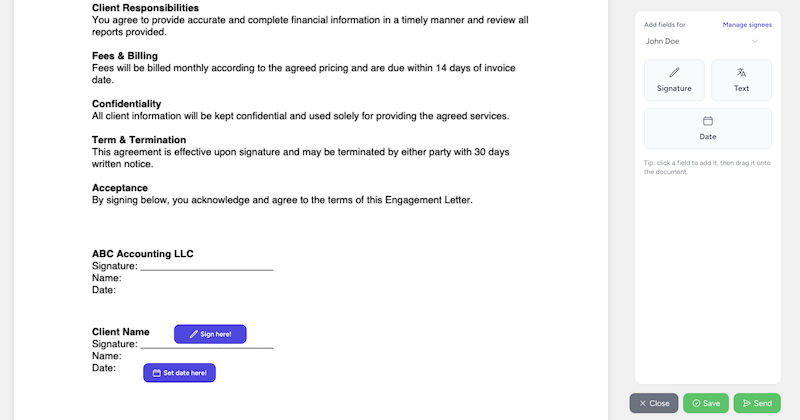
Draft an email to a new client attaching their engagement letter for [service type]. Briefly explain what the letter covers and ask them to review and sign it by [date]. Tone: welcoming and professional.
3. Document Request
Write an email requesting the following documents from a client for their [tax return / year-end accounts / BAS]: [list documents]. Include a deadline of [date] and explain what happens if documents are late. Tone: clear and friendly.
4. Late Document Follow-Up
Write a follow-up email to a client who hasn’t sent their requested documents. This is the second reminder. The deadline was [date]. Be polite but firm about the consequences of further delay. Tone: professional, slightly urgent.
5. Job Completion Notification
Draft an email to a client letting them know their [monthly bookkeeping / tax return / BAS] is complete. Summarize the key outcome in 1–2 sentences (e.g., refund amount, net profit). Include a link to their portal to view the full report.
6. Welcome Email for New Client
Write a welcome email for a new bookkeeping client. Include: how to access their client portal, what documents you need by [date], who their primary contact is, and how to reach your firm for questions. Tone: warm and professional.
7. Quarterly Advisory Meeting Prep
Using these anonymized financials [paste summary], draft 5 talking points for a quarterly advisory meeting. For each point, separate the observed data from possible explanations, list the client question needed to test those explanations, and suggest an action only when the evidence supports one. Include positive or stable trends as well as risks.
8. Year-End Tax Planning Reminder
Using this current official guidance [paste or link to source], draft an email inviting small business clients to discuss year-end tax planning before [date]. Mention 3–4 topics that may be worth reviewing, without implying they apply to every client or encouraging spending solely for a tax benefit. Include a clear professional-review disclaimer. Tone: helpful and informative.
9. Referral Request
Draft a short, natural email asking a happy client for a referral. Don’t be pushy. Include a one-liner they can forward to contacts. Tone: grateful and casual.
10. Response to Pricing Objection
A prospect said our bookkeeping fee of $[amount]/month is too expensive. Draft a response that explains the value included, how it compares to the cost of not having proper books, and offers to discuss their specific needs. Tone: confident, not defensive.
11. Overdue Invoice Reminder
Write a polite email reminding a client that invoice #[number] for $[amount] is [X] days overdue. Include payment options and ask them to contact you if there’s an issue. Tone: professional and understanding.
12. Scope Creep Conversation
Draft an email to a client who has been requesting services outside their engagement scope (e.g., asking for tax advice when they’re on a bookkeeping-only package). Explain the boundary diplomatically and offer the additional service as an add-on with pricing.
13. Client Offboarding
Write a professional email to a client you’re ending the engagement with. Be respectful, provide 30 days notice, and outline what they’ll need to transition to a new provider (access to their files, final deliverables, etc.).
14. Explaining a Tax Outcome
I need to explain to a non-financial client that they owe $[amount] in taxes this year, up from $[amount] last year. The main reason is [increased revenue / loss of deductions / one-time income event]. Write this in plain English that a non-accountant would understand. Tone: clear and reassuring.
15. Regulatory Change Notification
Write a brief email to clients about [specific regulatory change, e.g., new instant asset write-off threshold]. Explain what changed, who it affects, and what action (if any) clients need to take. Keep it under 200 words.
Try Tidyflow
Turn prompts into action.
Run client work end to end in Tidyflow. Watch a 4-minute demo, or start a free trial. No credit card required.
Financial Analysis & Reporting (Prompts 16–25)
16. Monthly P&L Summary
Summarize this P&L data for a non-financial business owner. Highlight revenue trend vs prior month, largest expense categories, and net profit. Keep it to 3–4 bullet points. [Paste anonymized P&L]
17. Cash Flow Explanation
A small business was profitable this month, but its bank balance fell. Using this anonymized P&L, balance sheet, and cash-flow data [paste], reconcile the change without assuming the cause. Show the cash impact of operating, investing, and financing movements in a simple table. If the data is insufficient, list what is missing instead of selecting a “common reason.”
18. KPI Dashboard Narrative
Using these anonymized KPIs [paste metrics], draft a 3-paragraph client advisory narrative. First describe the measured changes without judgment; then present possible explanations and the evidence needed to test them; finally suggest next steps supported by the data. Do not label a result healthy or concerning without a stated benchmark and relevant context.
19. Industry Benchmarking
Compare these financial ratios [paste anonymized data] with the benchmarks in this verified source: [paste or link to source]. Confirm the source’s industry, jurisdiction, sample period, and publication date before comparing. Highlight material differences and explain the limits of the comparison. If the source is missing or does not match, do not invent a benchmark; list the data needed instead.
20. Budget Variance Analysis
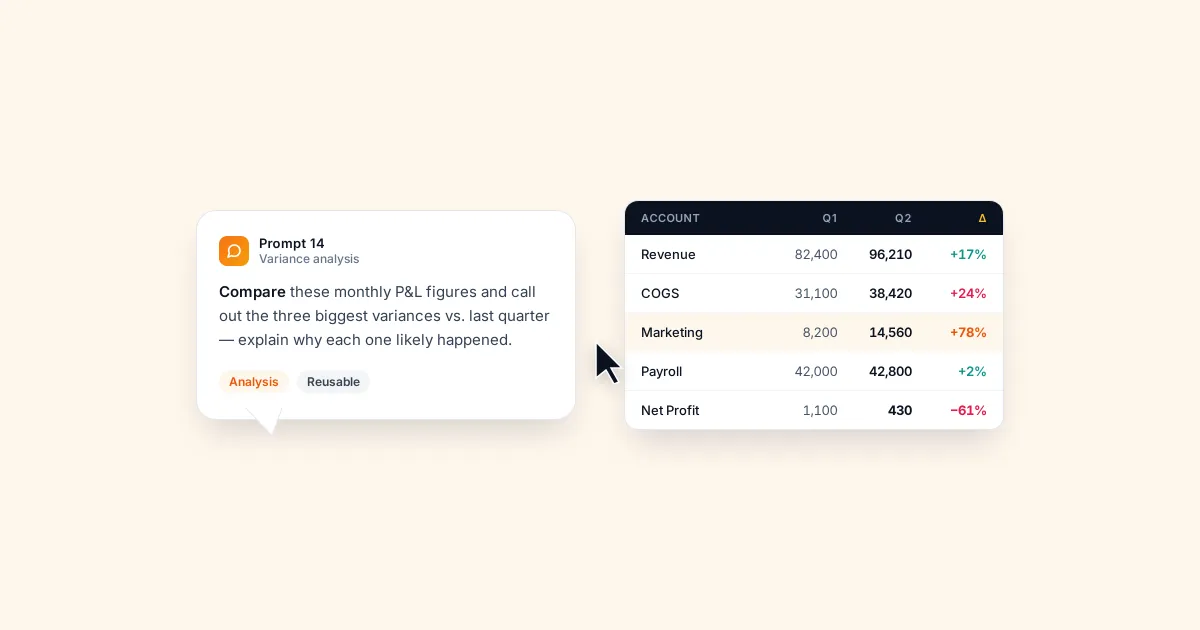
Compare these anonymized budget and actual figures [paste data]. For each line item with more than 10% variance, calculate the amount and percentage accurately, then list plausible explanations as hypotheses, not facts. Provide the questions or supporting records needed to determine the actual cause and whether it is one-time or recurring.
21. Break-Even Analysis Explanation
Explain the concept of break-even analysis to a small business client in plain English. Use their numbers: fixed costs $[X]/month, average margin [X]%. Show them their break-even revenue and what it means for their business.
22. Revenue Trend Analysis
Analyze this anonymized 12-month revenue data [paste]. Describe only patterns supported by the data, distinguish a recurring seasonal pattern from a one-off movement, and state when 12 months is not enough to decide. Include stable and positive observations as well as possible risks. Suggest 2–3 follow-up questions or actions, each tied to a specific observation.
23. Expense Reduction Recommendations
Review these anonymized expense categories [paste summary] for a small [industry] business. Do not assume spending is excessive or that a cut would leave operations unaffected. Identify up to 3 categories worth investigating, explain the evidence for each, and list the operational context or benchmark needed before recommending a change. If no category is clearly unusual, say so.
24. Client Financial Health Score
Review these metrics (revenue growth: [X]%, profit margin: [X]%, current ratio: [X], and accounts receivable days: [X]) alongside this verified industry benchmark and prior-period data [paste]. Explain what each metric can and cannot show. Do not produce a single “financial health” score from these four inputs. Identify missing measures, observations supported by the comparison, and up to 3 questions or next steps.
25. Loan Readiness Assessment
A client is considering a $[amount] business loan. Using this anonymized financial summary [paste] and the lender’s published criteria [paste or link], create a readiness checklist. Separate confirmed requirements, apparent gaps, and missing information. Do not predict approval or assume the client needs to “improve” a metric unless the lender’s criteria support that conclusion.
Research & Tax Questions (Prompts 26–35)
Use AI to plan and organize research, not as the authority for a tax or regulatory answer. Ask it to cite current primary sources, then open and verify those sources yourself before advising a client.
26. Deduction Research
Create a research checklist for common business tax deductions that may apply to a [industry, e.g., construction company] in [country] for the [year] tax year. Organize it by category, list the facts an accountant needs to confirm, and point to the relevant official tax-authority guidance. Do not determine eligibility or give a final tax position.
27. Entity Structure Comparison
Create a research framework for comparing [entity type A], [entity type B], and [entity type C] for a [industry] business in [state/country]. List the tax, legal, payroll, and administrative questions a qualified adviser should evaluate. Cite current government sources, flag jurisdiction-specific assumptions, and do not recommend an entity.
28. Depreciation Rules
Summarize the current official guidance on depreciation for [asset type] in [country] for the [year] tax year. Include links to primary government sources, quote no more than necessary, distinguish confirmed rules from assumptions, and list the client facts that could change the treatment.
29. Tax Deadline Summary
Draft a tax-deadline research table for [year] in [country/state] covering individuals, sole traders, companies, and trusts. For each date, include the relevant official source and mark any deadline that depends on filing method, extension, adviser status, or taxpayer circumstances as “verify.” Do not invent a date when a current source is unavailable.
30. State/Province Tax Differences
Build a research checklist comparing the possible business tax obligations for a [business type] operating in [State A] and [State B]. Cover income tax, sales tax, nexus or registration questions, and state-specific requirements. Link to each state’s official guidance and flag facts that require professional analysis.
31. R&D Tax Credit Eligibility
Summarize the official R&D tax credit eligibility criteria in [country], the records typically required, and the questions to ask a [industry type] business during an initial assessment. Cite current government guidance. Do not decide whether the business qualifies.
32. Home Office Deduction
Prepare a research brief on home office deduction rules for a self-employed [profession] in [country] for [year]. Compare the available calculation methods using current official sources, list the eligibility facts to confirm, and flag areas that require professional judgment.
33. Vehicle Deduction Methods
Create a comparison worksheet for the standard mileage rate and actual expense method in [country] for [year]. Use current official sources, list the records needed for each method, and show which inputs an accountant would need to calculate both outcomes. Do not recommend a method without the full facts.
34. New Client Industry Research
I’m onboarding a new client in the [industry] sector in [jurisdiction]. Create a discovery checklist covering common accounting challenges, potential deductions to research, industry-specific compliance topics, records to request, and questions to ask. Separate general workflow ideas from claims that require verification against an official source.
35. Regulatory Update Summary
Using the text or official source for [specific legislation or regulation], draft a change summary for professional review. Separate what changed, the effective date, who may be affected, transitional rules, and possible client actions. Cite the primary source for every claim, flag uncertainty, and do not provide advice.
Internal Operations (Prompts 36–45)
36. SOP Creation
I’m going to describe our monthly bookkeeping process. Turn it into a step-by-step Standard Operating Procedure (SOP) with numbered steps, clear action verbs, and decision points. Here’s the process: [describe in bullet points]
37. Job Description
Write a job description for a [junior bookkeeper / senior accountant / admin assistant] at a small accounting firm. Include responsibilities, required skills, and nice-to-haves. The firm uses QuickBooks Online or Xero and [Tidyflow/other PM tool].
38. Interview Questions
Generate 10 interview questions for a [role] candidate at a small accounting firm. Mix technical questions (bookkeeping/accounting knowledge) with behavioral questions (client service, time management, attention to detail).
39. Onboarding Checklist for New Employee
Create an onboarding checklist for a new [bookkeeper / accountant] joining a small accounting firm. Cover first day, first week, and first month, including system access, training, and client introductions.
40. Team Meeting Agenda
Create a 15-minute weekly team meeting agenda for a small accounting firm. Focus on: workload check-in, deadline risks, blockers, and priorities for the week.
41. Client Service Standards Document
Draft a brief client service standards document for a small accounting firm. Cover response times, communication channels, deliverable timelines, and escalation procedures.
42. Process Improvement Analysis
We currently use this process: [describe each step, volume, people involved, wait time, rework, and known constraints]. Map the process, identify bottlenecks supported by the details, and ask for any missing timing data. Suggest up to 3 low-cost experiments, with implementation steps, risks, and a method for measuring actual time saved. Label any time estimate as an assumption rather than a promised result.
43. Email Template Library
Create 5 email templates for common accounting firm communications: document request, job completion, meeting scheduling, engagement letter follow-up, and quarterly check-in. Keep each under 150 words.
44. Pricing Review Prep
Analyze this service using monthly price $[X], delivery time [X] hours, labor arrangement and cost [describe], and other delivery costs [list]. First classify each cost as variable, fixed, or unknown and explain the classification. Calculate contribution margin using only variable costs, show the formula, and distinguish it from accounting gross margin. If cost behavior is unclear, ask for the missing information instead of calculating. Run sensitivity cases for [hours/cost assumptions]. Do not recommend a price change from this calculation alone; list the capacity, market, scope, and client-value information needed for that decision.
45. Annual Client Review Preparation
I’m preparing for an annual review with a [industry] client in [jurisdiction]. Using this anonymized client history [paste] and these verified industry sources [paste or link], generate 5 discussion topics. Tie each topic to the client’s facts, include a neutral discovery question, and distinguish general industry context from client-specific evidence. Do not assume the client has a “common” problem.
Marketing & Content (Prompts 46–50)
46. LinkedIn Post Ideas
Generate 5 LinkedIn post ideas for an accountant targeting [small business owners / e-commerce sellers / construction companies]. Each should be practical, shareable, and under 200 words. Include a hook opening line.
47. Blog Post Outline
Create a detailed outline for a blog post titled “[topic]” targeting [audience]. Include an introduction, 5–7 main sections with subpoints, and a conclusion with a CTA. Aim for 2,000 words.
48. Client Testimonial Request
Draft a short email asking a client for a testimonial. Include 3 specific questions to guide their response: What was your situation before working with us? What’s been the biggest benefit? Would you recommend us?
49. Google Business Profile Description
Write a Google Business Profile description for an accounting firm in [city] specializing in [niche]. Include services, what makes us different, and a call to action. Max 750 characters.
50. Email Newsletter Draft
Draft a short monthly email newsletter for accounting clients. Include: one tax tip for this month, one deadline reminder, and one brief firm update. Keep the total under 300 words.
ChatGPT Prompts for Outsourced Accounting Firms (Prompts 51–55)
Outsourced accounting firms run recurring engagements, including monthly closes, ongoing bookkeeping, and reporting packages, across many clients at once. The highest-value prompts are the ones that standardize handoffs, status updates, and onboarding. These five follow the same structure as the rest of the list, and they work in ChatGPT, Claude, or any general assistant (here’s how the two compare for accounting work).
51. Outsourced Accounting Proposal Outline
Draft a proposal outline for outsourced accounting services for a [industry] business with roughly [X] monthly transactions and [X] employees. Cover scope of services ([bookkeeping / payroll / accounts payable / management reporting]), explicit exclusions, monthly deliverables and their timing, communication and response-time expectations, and what the client remains responsible for. Leave a placeholder section for pricing. Format as headings with bullet points.
52. Monthly Close Status Update
Draft a status update email to a client whose monthly close we manage. The [month] close is [on track / delayed]. Completed: [list]. Outstanding items we’re waiting on from the client: [list, with the date each was requested]. Expected delivery of the reporting package: [date]. Lead with the overall status, make the client’s action items impossible to miss, and keep it under 150 words. Tone: organized and calm.
53. In-House to Outsourced Transition Checklist
Create a transition checklist for taking over bookkeeping from a client’s [departing in-house bookkeeper / previous provider]. Cover system access and admin rights, open items and unreconciled balances, recurring monthly tasks and their timing, payroll and vendor payment responsibilities, document storage locations, and a handover meeting agenda. Organize it by week for the first [X] weeks, and flag any item where missing information would block the first close.
54. New Outsourced Client Discovery Questions
Generate a discovery question list for onboarding a new outsourced accounting client in the [industry] sector. Cover their current processes for [invoicing / bills / payroll / expense claims], the systems they use, who approves what today, the month-end deadlines they need us to hit, and the reporting they expect. Group questions by topic and order them so a 60-minute onboarding call flows naturally. Do not assume their current setup is wrong.
55. Service Handoff Instructions for the Team
Turn these notes about a client’s [monthly bookkeeping / accounts payable] process into work instructions a team member can follow without asking questions: [paste anonymized notes]. Use numbered steps, name the system used at each step, state what “done” looks like, and list the checks to perform before marking the work complete. Where my notes are ambiguous or incomplete, flag the gap instead of guessing.
Try the safer copy, prompt, paste series
A useful prompt is only one part of the workflow. The harder part is preparing real firm data without exposing client identifiers, then checking the result before it becomes an email, task, or decision.
Start with the free Client Data Redactor. It replaces values it recognizes with reversible placeholders inside your browser. Review the redacted text manually, copy it into your firm’s approved ChatGPT or Claude account, then restore placeholders only after the draft has been checked.
Use the complete walkthrough for the job in front of you:
- Draft document follow-ups from a missing-document list. Turn spreadsheet rows into separate emails without inventing deadlines or consequences.
- Turn a client email thread into tasks. Extract owners, dates, dependencies, and open questions with a source quote for every task.
- Audit an accounting workflow spreadsheet. Find missing owners, stale work, inconsistent statuses, and likely duplicates while keeping the source sheet authoritative.
Each guide uses the same pattern: share less data, replace identifiers, give the assistant narrow rules, demand evidence, and have a person approve the result.
Tips for Better AI Results
Be specific. “Write an email” gets a generic result. “Write a 150-word email to a small business client explaining why their tax bill increased 30% due to reduced depreciation deductions” gets a useful result.
Set the tone. Always include a tone instruction: professional, friendly, empathetic, firm, casual. AI defaults to generic corporate-speak without guidance.
Provide context. The more relevant context you give, the better the output. Industry, client type, firm size, and specific numbers all help.
Iterate. The first output is rarely perfect. Ask “make this shorter,” “add more specific examples,” or “adjust the tone to be more direct.”
Ask for assumptions. Tell the AI to separate facts you provided from assumptions it made. This makes gaps easier to spot.
Avoid leading questions. “Why did expenses become inefficient?” assumes both a cause and a judgment. Ask “What changed in expenses, what evidence could explain it, and what information is missing?” Tell the AI to challenge your framing, consider contrary evidence, and say when the data does not support a conclusion.
Demand source discipline. For factual research, ask for current primary sources and verify that every link and claim is real. AI-generated citations can be wrong or fabricated.
Always review. AI can be wrong about tax law, regulations, calculations, and financial specifics. Recalculate figures, check current official guidance, and never send AI-generated advice without qualified professional review.
For more on how to use AI effectively in your firm, see our AI for accounting firms guide, or look at Tidyflow’s built-in AI assistant, which already has your firm’s jobs, clients, and invoices as context instead of needing them pasted in.
Want these 55 prompts as a PDF?
We'll email you the full prompt pack, organized by category and ready to paste into ChatGPT whenever you need it.
No spam. Unsubscribe anytime. See our privacy policy.
Check your inbox
We've sent the template to your email. If it doesn't arrive in a few minutes, check your spam folder or reply to support@tidyflow.com and we'll resend.
Frequently asked questions
What are the best ChatGPT prompts for accountants?
The best prompts give ChatGPT a clear role, relevant context, one specific task, constraints, and the required output format. Strong accounting use cases include drafting client emails, turning a process into an SOP, summarizing anonymized financial trends, and preparing a research checklist.
How can accountants use ChatGPT safely?
Never paste client-identifiable or confidential information into a public AI tool. Anonymize inputs, follow your firm’s data and AI policies, use an approved business product with appropriate privacy controls, and have a qualified professional verify every financial, tax, regulatory, and client-facing output.
Can ChatGPT give accounting or tax advice?
ChatGPT can help organize questions, create research plans, and explain source material, but it can produce outdated or incorrect answers. Do not rely on it for accounting or tax advice. Verify claims against current primary sources and apply professional judgment.
What information should an accounting prompt include?
Include the role, audience, relevant anonymized context, exact task, constraints, output format, verification instruction, and a reminder not to assume your framing is correct. Replace the bracketed placeholders in these prompts before using them.
How can accountants use ChatGPT?
Accountants use ChatGPT to draft client emails, turn process notes into SOPs, summarize anonymized financial data in plain English, build research checklists, and create marketing content. It works best as a first-draft tool: give it a role, anonymized context, one task, constraints, and a format, then have a qualified professional review the output before it reaches a client.
Can ChatGPT do accounting?
No. ChatGPT cannot do accounting on its own. It does not connect to your ledger, it can miscalculate, and it can state tax rules incorrectly. It can draft communication, explain concepts, structure checklists, and summarize anonymized data you provide. Bookkeeping, reconciliation, tax preparation, and advice still require accounting software and a qualified professional who verifies every output.