Try Tidyflow
Get your firm organized.
Watch a 4-minute demo, or start a free trial. No credit card required.
Acquiring a new accounting client costs 5–7x more than retaining an existing one. Yet most firms spend far more time on marketing and business development than on keeping the clients they already have.
Client retention in accounting isn’t about loyalty programs or thank-you gifts. It’s about consistently delivering value, communicating well, and making it easy for clients to work with you. This guide covers what actually moves the needle.
Why Clients Leave Accounting Firms
Before you can retain clients, you need to understand why they leave. The top reasons aren’t what most firm owners think:
Poor communication — the #1 reason. Clients don’t leave because the tax return was wrong. They leave because they emailed three times and didn’t get a response. Or because they never hear from you unless there’s a problem.
Feeling like a number — small business owners want to feel like their accountant understands their business. When every interaction is transactional (“send your documents, here’s your return”), clients feel interchangeable.
Unclear value — if a client pays $500/month and doesn’t understand what they’re getting, they’ll eventually question whether it’s worth it. Especially when a competitor offers a lower price.
Life events — a client sells their business, retires, or moves to a different country. You can’t control these, but they’re a smaller percentage than the controllable factors above.
Strategy 1: Communicate Proactively
The easiest way to retain clients is to communicate before they have to chase you.
What Proactive Communication Looks Like
- Job status updates: “Your tax return is in progress, we expect to have it ready by Thursday”
- Deadline reminders: “Your BAS is due on the 28th — we’ll need your documents by the 20th”
- Regulatory changes: “The government announced changes to the instant asset write-off threshold. Here’s what it means for your business.”
- Year-end summaries: “Here’s a snapshot of your business performance this year compared to last year.”
You don’t need to send a weekly newsletter. A few timely, relevant updates per quarter show the client you’re thinking about their business — not just waiting for them to contact you.
Set a Communication Cadence
For each client, define a minimum communication schedule:
| Client Type | Minimum Proactive Touchpoints |
|---|---|
| Monthly bookkeeping | Monthly summary + quarterly call |
| Quarterly compliance | Pre-deadline reminder + post-lodgement summary |
| Annual tax only | 2 proactive emails/year + year-end call |
| Advisory clients | Monthly or fortnightly check-in |
Even “annual tax only” clients should hear from you more than once a year. Two well-timed emails (mid-year tax planning tips, end-of-year document reminder) keep you top of mind.
Strategy 2: Deliver Obvious Value
Clients stay when they can clearly see what they’re getting. The problem is that much of what accountants do is invisible — compliance work happens behind the scenes, and the client just sees a final document.
Make your work visible:
- Send a brief summary with every deliverable. Instead of just lodging the BAS, send a one-paragraph note: “Your BAS for Q2 shows a $3,200 refund due to higher input tax credits from the equipment purchase in April. Refund should arrive in 10–14 days.”
- Show the before and after. “Last year your tax was $X. This year, after implementing the structure changes we discussed, it’s $Y. That’s $Z in savings.”
- Quantify your impact. “We identified $14,000 in unclaimed deductions during your review.” Numbers make value tangible.
Expand beyond compliance:
Compliance work (tax returns, BAS, accounts) is the baseline. Clients expect it but don’t get excited about it. To differentiate:
- Offer a short advisory insight with each deliverable (“based on your Q2 numbers, you might want to consider making a super contribution before June 30”)
- Flag potential problems early (“your accounts receivable is growing — you have $23K outstanding over 60 days”)
- Suggest improvements (“you’re paying $400/month in bank fees across three accounts — consolidating could save you $2,800/year”)
You don’t need a formal advisory service to do this. Even one useful observation per quarter positions you as a trusted advisor, not just a compliance factory.
Strategy 3: Make It Easy to Work With You
Friction drives clients away. Every pain point in your process — clunky portals, unclear requests, slow response times — gives clients a reason to look elsewhere.
Remove Friction Points
- Simplify document submission. Use a client portal with clear checklists. One place to upload, specific list of what’s needed, automated reminders. No more “send your stuff over when you get a chance.”
- Respond quickly. You don’t need to solve the problem immediately, but acknowledge the email same-day. “Got it, I’ll have an answer by Thursday” is far better than silence.
- Don’t make clients repeat themselves. If a client told you about a property purchase last month, don’t ask about it again this month. Keep good notes.
- Make billing predictable. Surprise invoices destroy trust. Fixed fees, clear scope, and invoices that match what was agreed — every time.
Use Technology That Helps (Not Hinders)
Your tech stack should make the client experience better, not worse. If your portal is harder than email, clients will email. If your invoicing is clunky, clients will delay payment.
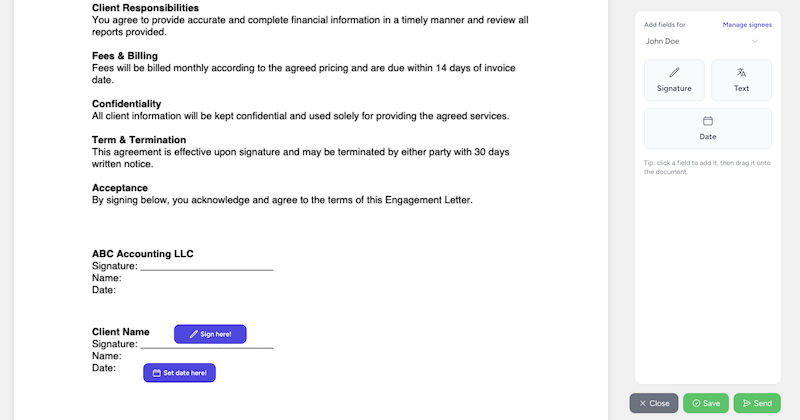
Tidyflow is designed with the client experience in mind. Its client portal is simple for clients to use — upload documents, respond to requests, sign engagement letters — without requiring them to navigate complex software. Automated reminders handle follow-ups, so you’re not chasing clients manually, and they’re not getting annoyed by constant personal emails.
Strategy 4: Build Relationships, Not Just Transactions
Accounting is inherently a relationship business. The firms with the highest retention rates are the ones where clients feel genuinely known.
Practical ways to build relationships:
- Remember the details. Note personal details in your CRM — spouse’s name, kids, hobbies, business goals. Reference them naturally in conversations.
- Assign consistent contacts. Don’t rotate the client through different team members every year. Continuity builds trust.
- Celebrate milestones. A brief congratulations email when a client’s business hits a revenue milestone or anniversary shows you’re paying attention.
- Be honest about bad news. If the tax bill is higher than expected, explain why directly. Don’t bury bad news in jargon. Clients respect honesty far more than spin.
Strategy 5: Price Fairly and Communicate Value
Price is rarely the real reason a client leaves — it’s a convenient excuse when the real reason is one of the above. But pricing mistakes can accelerate departures:
Don’t spring fee increases without context. If you’re raising prices, explain why: “We’re expanding our service to include quarterly check-in calls and proactive tax planning updates.” Clients accept price increases when they come with more value.
Review profitability per client annually. Some clients cost you more than they pay. Either reprice them, reduce scope, or let them go. Unprofitable clients drain your team’s time and energy — resources better spent on clients who value your work.
Offer tiered services. Not every client needs or wants your full service package. A bookkeeping-only tier at a lower price point can retain price-sensitive clients who would otherwise leave.
For guidance on structuring your pricing, see our guide on pricing accounting services.
Strategy 6: Catch At-Risk Clients Early
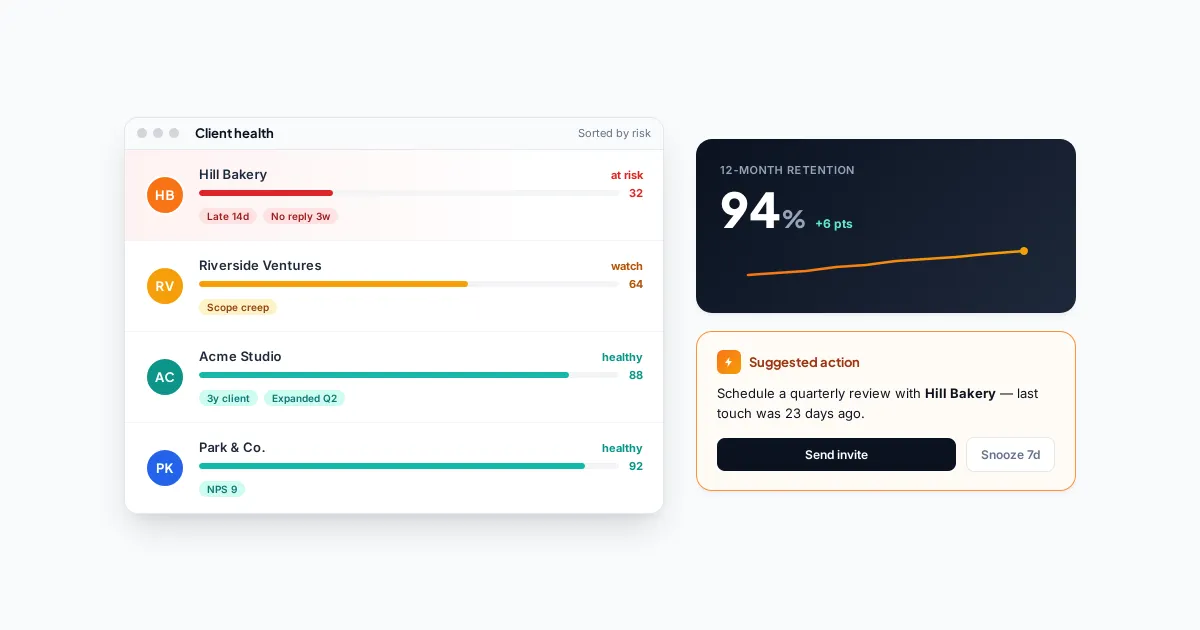
Clients rarely leave without warning. Watch for these signals:
- Decreasing communication — a previously responsive client goes quiet
- Late payments — invoices that used to be paid in 7 days now take 30+
- Complaints or frustrations — even small ones add up
- Requesting their files — this is often the final stage
- Asking about other services they’re “considering” — code for “I’m shopping around”
When you spot these signals, reach out directly:
“Hi [Client Name], I noticed we haven’t connected in a while. I wanted to check in and make sure everything’s going well with our service. If there’s anything we could do differently, I’d genuinely like to hear it.”
A proactive conversation when you sense something is off can save a client relationship that might otherwise quietly end.
Strategy 7: Get Feedback Regularly
You can’t fix problems you don’t know about. Build feedback into your process:
- Post-engagement survey (keep it to 3–5 questions): How was the experience? What could we improve? Would you recommend us?
- Annual check-in call: Review the past year, discuss the year ahead, and ask directly: “Is there anything about our service you’d change?”
- Exit interviews: When a client does leave, ask why. The answer is valuable — even if it stings.
Don’t use feedback only for damage control. Positive feedback tells you what to keep doing, which is just as important as knowing what to fix.
Measuring Retention
Track these metrics:
- Client retention rate — (clients at end of year ÷ clients at start of year) × 100. Target: 90%+ for accounting firms.
- Revenue retention rate — same formula but with revenue instead of headcount. This accounts for clients who stay but downgrade services.
- Average client tenure — how long clients stay with your firm on average. Growing tenure = improving retention.
- Net Promoter Score — would your clients recommend you? A simple question with powerful insights.
The Retention Flywheel
Client retention isn’t a project — it’s a system. Each retained client:
- Provides predictable revenue (easier to plan and grow)
- Refers new clients (cheapest acquisition channel)
- Requires less time to serve (you already know their business)
- Generates higher lifetime value (cross-sell and upsell opportunities)
Investing in retention pays compounding returns. A client who stays 5 years is worth dramatically more than 5 one-year clients, even at the same annual fee — because you spend less time onboarding, building trust, and learning their business.
Start with the strategy that addresses your biggest weakness. If clients complain about communication, fix that first. If they don’t understand your value, start sending summaries with every deliverable. Small, consistent improvements compound into dramatically better retention over time.