Try Tidyflow
Get your firm organized.
Watch a 4-minute demo, or start a free trial. No credit card required.
A client intake form is the fastest way to collect everything you need from a new client in one go, instead of chasing details over a dozen emails. This guide covers exactly what an accounting client intake form should include, gives you a free template to copy, and shows where it fits in your onboarding process.
Prefer to start from your own selection of questions? You can build your own customized intake form with the free interactive builder: pick a client type, toggle the sections you need, add your own questions, and download it for Word.
What is a client intake form?
A client intake form is a structured questionnaire you send to a new client to gather their business details, contacts, financial setup, and the information you need to start work. For accounting firms it does two jobs at once: it collects the practical details you need to set up the engagement, and it captures the identity and ownership information required for know-your-client (KYC) and anti-money-laundering (AML) checks.
Done well, a single intake form replaces the back-and-forth that usually eats the first two weeks of a new engagement.
What to include in an accounting client intake form
Business information
- Legal entity name and trading name
- Entity type (sole trader, partnership, company, trust)
- Business/tax registration numbers (EIN, ABN, company number, VAT/GST number as applicable)
- Registered and trading addresses
- Industry and a one-line description of the business
- Date the business started
Primary contact
- Full name and role
- Email and phone
- Preferred contact method and best times
- Whether they are authorised to act on the entity’s behalf
Additional contacts
- Other people you’ll deal with (bookkeeper, office manager, business partner)
- Their role and what they’re authorised to discuss
Current financial setup
- Accounting software in use (QuickBooks, Xero, or other) and how you’ll get access
- Who currently does the bookkeeping
- Prior accountant’s details, if switching firms
- Bank and payment processors used
- Payroll provider, if any
Services required
- The services the client wants (bookkeeping, tax preparation, payroll, advisory)
- Frequency (monthly, quarterly, annual)
- Any immediate issues or deadlines they’re worried about
Key dates and deadlines
- Financial year end
- Upcoming filing or payment deadlines
- Any dates already at risk
Know-your-client (KYC) details
- Identity verification for signatories (government ID, proof of address)
- Beneficial owners (typically anyone with 25%+ ownership or effective control)
- Source of funds where your AML policy requires it
Free accounting client intake form template
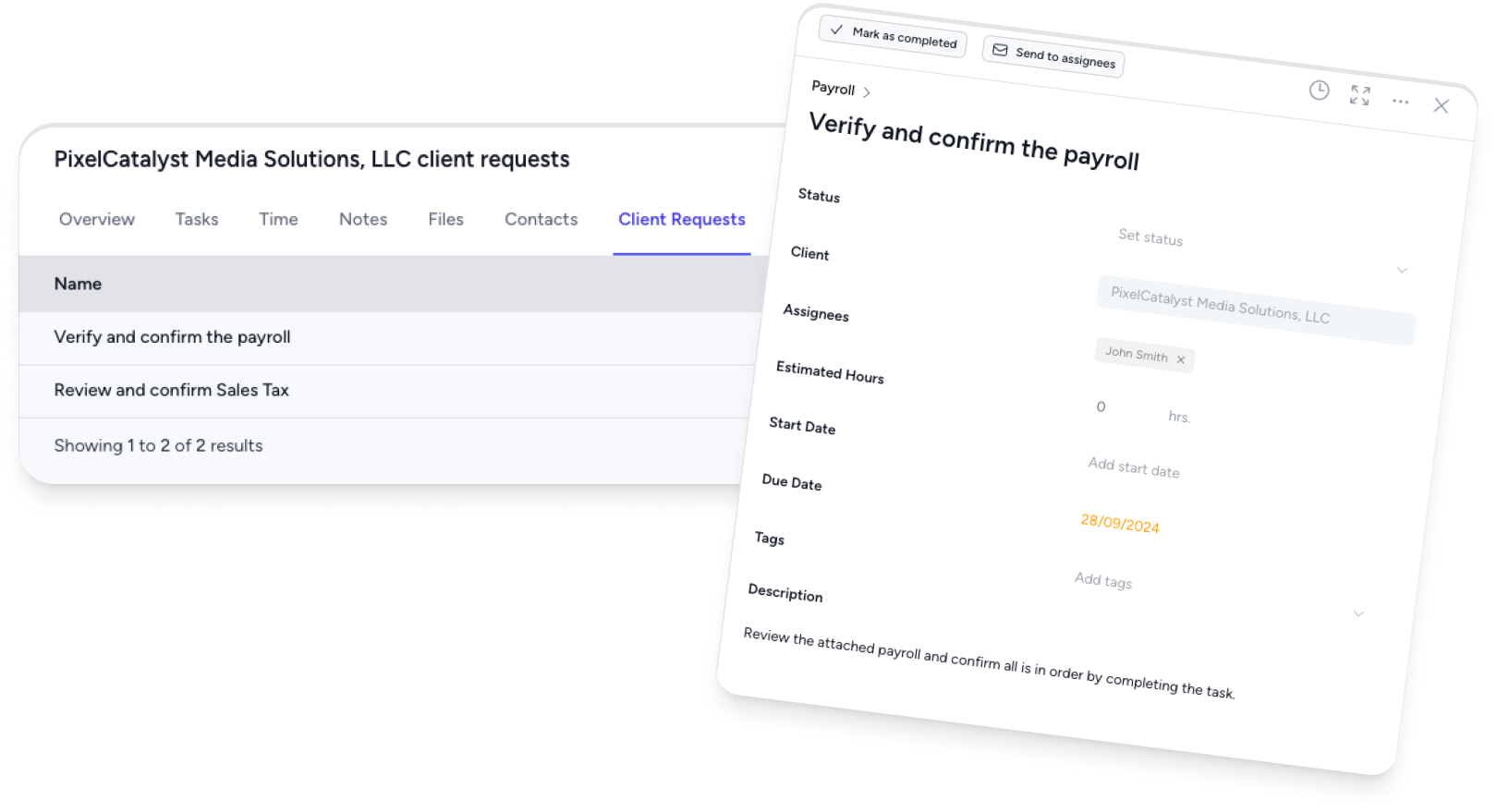
Copy the fields below into your own form, or rebuild them as a digital client request so responses feed straight into your workflow:
Business: Legal name · Trading name · Entity type · Registration/tax numbers · Addresses · Industry · Start date
Primary contact: Name · Role · Email · Phone · Preferred contact method · Authorised to act? (Y/N)
Additional contacts: Name · Role · What they’re authorised to discuss
Financial setup: Accounting software + access · Current bookkeeper · Prior accountant · Banks · Payroll provider
Services: Services needed · Frequency · Immediate concerns
Key dates: Financial year end · Upcoming deadlines · Dates at risk
KYC/AML: ID for signatories · Beneficial owners (25%+ ownership/control) · Source of funds (if required)
Paper form vs digital intake
A PDF or paper intake form works for your first few clients, but it doesn’t scale. Every returned form has to be read and re-keyed into your systems, chased when it’s incomplete, and stored somewhere you’ll actually find it again.
A digital intake form fixes all three problems. Clients complete it online, you can see at a glance what’s outstanding, automatic reminders chase the gaps, and the answers land straight in your workflow with nothing to re-type. In Tidyflow you can turn this template into a reusable client request that collects the information and any supporting documents in one secure step.
Best practices for client intake
- Send it early. As soon as the engagement letter is signed, so you have everything before you start work.
- Ask only what you’ll use. A shorter form gets completed; a 60-field form gets abandoned.
- Make it easy to return. Online beats a printable PDF the client has to fill, scan, and email back.
- Chase missing fields automatically. Don’t let an incomplete form stall the engagement.
- Store it where the work happens. The intake details should live against the client record, not in an inbox.
Where the intake form fits in onboarding
The intake form is one step in a bigger process. For the full sequence, from engagement letter and KYC checks through to the kickoff meeting, see our accounting client onboarding checklist, which includes a complete checklist you can run as a job template.
Frequently asked questions
What should an accounting client intake form include?
At minimum: business and entity details, primary and additional contacts, current accounting software and financial setup, the services the client needs, key deadlines, and the identity and beneficial-ownership details you need for know-your-client (KYC) and anti-money-laundering checks.
What’s the difference between a client intake form and an engagement letter?
The intake form collects the information you need to do the work (contacts, entity details, software access, deadlines). The engagement letter is the contract that defines scope, fees, and responsibilities. You typically send the intake form alongside or just after the signed engagement letter.
Should an accounting client intake form be paper or digital?
A digital intake form is faster to complete, easier to chase, and feeds straight into your systems without re-keying. Paper or PDF forms mean manual data entry and version confusion. Most firms move to a digital client request or form as soon as they onboard more than a handful of clients a year.
When should you send the client intake form?
Send it as soon as the engagement letter is signed, during the first few days of onboarding. Collecting this information early means you have everything ready before you start the actual work, rather than stopping midway to chase missing details.