Accounting firm succession planning is how you retire, slow down, or share leadership without the firm depending on a scramble. Clients still get their returns and their monthly books. The team still knows who decides. You choose the timing, instead of a health event, a burned-out team, or an offer you did not ask for choosing it for you.
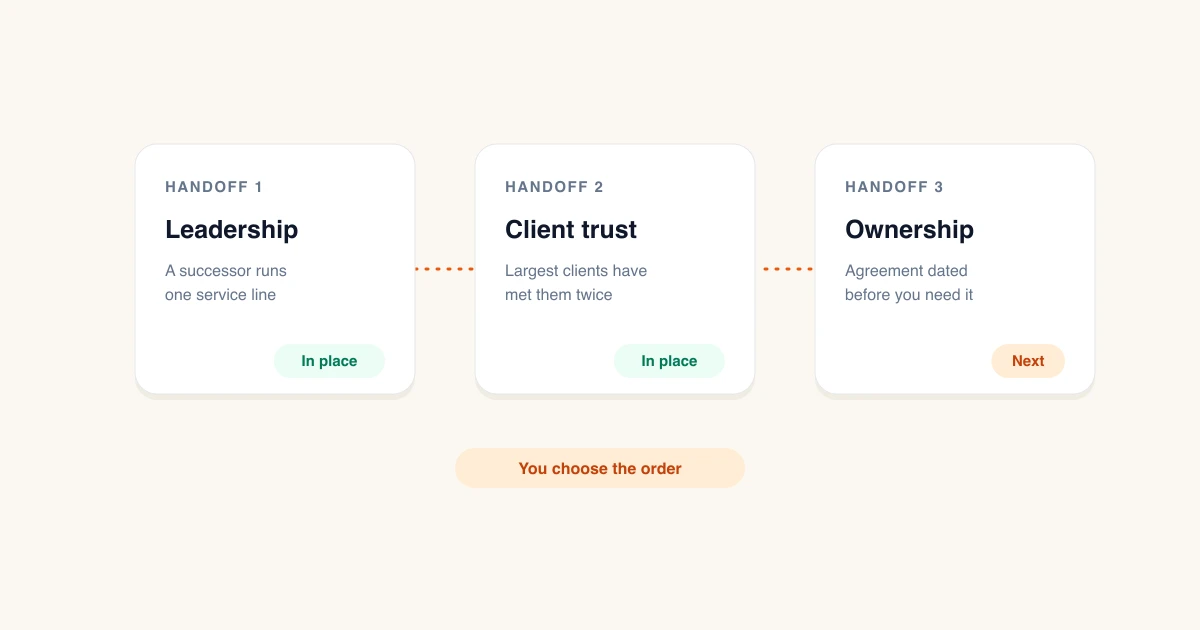
The short version: split the problem into three handoffs. Who leads, who the clients trust, and who owns the equity. They can move in different years. Firms that treat succession as one transaction lose control of the parts they could have prepared while they were still in charge.
This guide is for owners who want that control, and for the people they hope will take over. An outside sale is one option, not the assumption. For the operating checklist underneath a sale, use the sale-readiness checklist. To understand price without treating a multiple as a fact, use accounting practice valuation.
Three handoffs, not one event
“I need a succession plan” usually means several projects bundled together.
| Handoff | The question | You still control it when |
|---|---|---|
| Leadership | Who manages the team, the calendar, and the exceptions? | Someone else already runs a service line without you |
| Client trust | Who do the clients call when the work is ordinary? | Your largest clients have met that person, more than once |
| Ownership | Who holds equity, and on what terms do you get paid? | The agreement exists before you need it, and you helped write the timing |
A firm can change leadership and keep the same owners. Two partners, one of whom stops reviewing every return, is a succession step. A firm can also change ownership on paper and leave every client calling the retiring partner. That is a transaction with the operational risk still attached, and buyers and remaining partners both notice.
Control means you pick the sequence while you have the energy to introduce people and correct the plan. It does not mean gripping every file until the last Friday. If you have not taken a two-week break in years, you do not yet know whether the firm can function without you. Find out on purpose.
Start while the firm still feels stable
The useful time to plan is when nothing is on fire. A successor needs seasons, not a memo.
Several years out, you are choosing who can review, who can quote a fee, and who can sit in the meetings you used to handle alone. You are also writing down the work only long tenure knows, then watching someone follow it.
Inside two years, you are overlapping. The successor owns a book of recurring work, and clients have heard you say this is who they will work with. Your role is introductions, exceptions, and the decisions you listed as still yours. If an outside sale is possible, the sale-readiness work should already be mostly done. A firm that only works when you are present gets priced that way.
In the final season, you stay visible and become less necessary. Do not quietly take the hard files back. That teaches clients the handoff was temporary.
If health, family, or fatigue shortens the horizon, compress the overlap. Name one service line, one reviewer, and the clients who need an introduction. A partial plan you run beats a complete plan you announce on the way out.
A sole owner does not need a buyer in the building to start. A senior preparer, a contract reviewer, or a future partner can take on leadership and client trust while the equity stays entirely yours.
Partners and the internal path
An internal successor already understands the clients and is willing to own the outcome, not only the task. Willingness matters as much as skill. A talented preparer who does not want to manage, price, or sit with unhappy clients is the wrong answer to a leadership question, and that is no failing of theirs. Ask directly. Guessing wastes years.
What to hand them before equity
Before you talk about shares, the person should have done the job in public:
- Owned a recurring book, with their name on the jobs, for at least a full annual cycle
- Reviewed someone else’s work against a written standard, not against “what you would have done”
- Joined client conversations for the relationships they would inherit
- Seen the firm’s numbers the way an owner does: fees, collections, who is over capacity, which work makes money
Capacity planning belongs on that list. If you hand someone a book that only fits because you absorb the overflow, you have handed them your backlog, not a role.
Pay has to make the role worth taking while they are still an employee. People do not stay for a vague promise of partnership “when the time is right.” A clear path, reviewed on a date you both know, and pay that reflects the responsibility they already carry keep better candidates than a speech about loyalty.
What the agreement has to cover
When there is more than one owner, or you are about to create a second, the owners’ agreement is the legal half of the plan. Have a lawyer who works with professional firms draft it. Know which decisions you want it to make:
- How an owner steps back, and over what period
- How the interest is priced for an internal retirement, which is usually a different number from an outside sale
- How long payments run, and what happens if clients leave or fees fall
- What the retiring owner will still do, for how many hours, and who can tell them to stop
- What happens if an owner dies or cannot work
- Who can sign, hire, and commit the firm during the overlap
Read the agreement you already have first. Many firms find that retirement pay, voting, and disability were left as a paragraph from the year they formed. Updating it while everyone is healthy is control. Updating it when someone wants out is a negotiation under stress.
If the likely successor is family, write the role as you would for anyone else. The rest of the team needs a standard, not a last name.
If you are the successor
Much of this guide asks the owner to let go. The other half is yours: become the person clients and staff already treat as the next owner before anyone announces it.
Ask for a book of recurring work with your name on the jobs, and run it for a full cycle. Ask for the review standard in writing, then review against it. Ask to join client conversations, and follow up yourself so clients learn your name from the work, not from a letter. Ask to see the numbers. You cannot price a renewal or argue for a hire without them.
Write down what you learn as you go. Every quirk the owner explains once belongs on the client record or the job template, because the next person will need it from you.
When there is no one inside who will buy
Many small firms do not have a second owner in the building and will not grow one in time. That is a common fact, not a personal failure. Succession then means preparing the firm so a transition outward is possible on your timing:
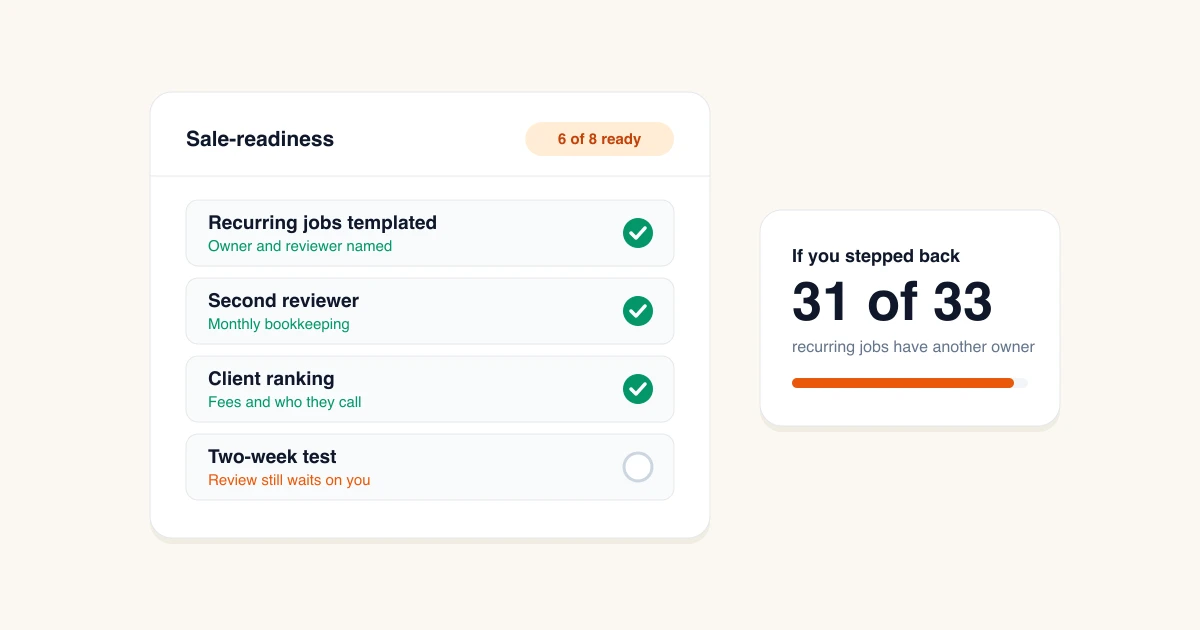
- Recurring jobs run from templates, with a reviewer who is not you whenever the risk allows
- Client relationships have a second face
- The fee mix, concentration, and scope are written down, so you are not reconstructing the practice for a stranger
- Staff know you are building a firm that can be transferred, even without a date
An outside sale or a merger can be the ownership handoff at the end of that work. It can also prove unnecessary if you find a partner later, or choose to shrink the firm to a size you can carry longer. Decide on the merits of your life and your team. Do not let the absence of an internal buyer rush you into a conversation you have not prepared for. If a price conversation does start, the valuation guide covers what buyers look at and why terms matter as much as the multiple.
Also plan for the transition you do not schedule. A practice-continuation arrangement, or the disability section of an owners’ agreement, names who can serve clients if you cannot: a peer firm, a partner, or someone on your team with the right licenses. Ask your attorney and your state society what your jurisdiction expects.
Write down the knowledge that walks out with you
Tribal knowledge is the real procedure: the client who sends documents in three emails, the entity whose books always run a month behind, the return that looks wrong if you follow last year blindly, the review note you have never typed. Successors do not fail for lack of a textbook. They fail because the textbook was you.
Document in fee order: the highest-volume recurring service, review and what must come back to an owner, onboarding, billing exceptions, and the seasonal jobs that get dropped when everyone is tired, such as estimates, extensions, and payroll or sales-tax filings.
The process documentation guide shows a short SOP shape and warns against the 200-page manual. Where a step says “use your judgment,” add the signal that should trigger a question: a variance, a missing document, a client over a fee threshold.
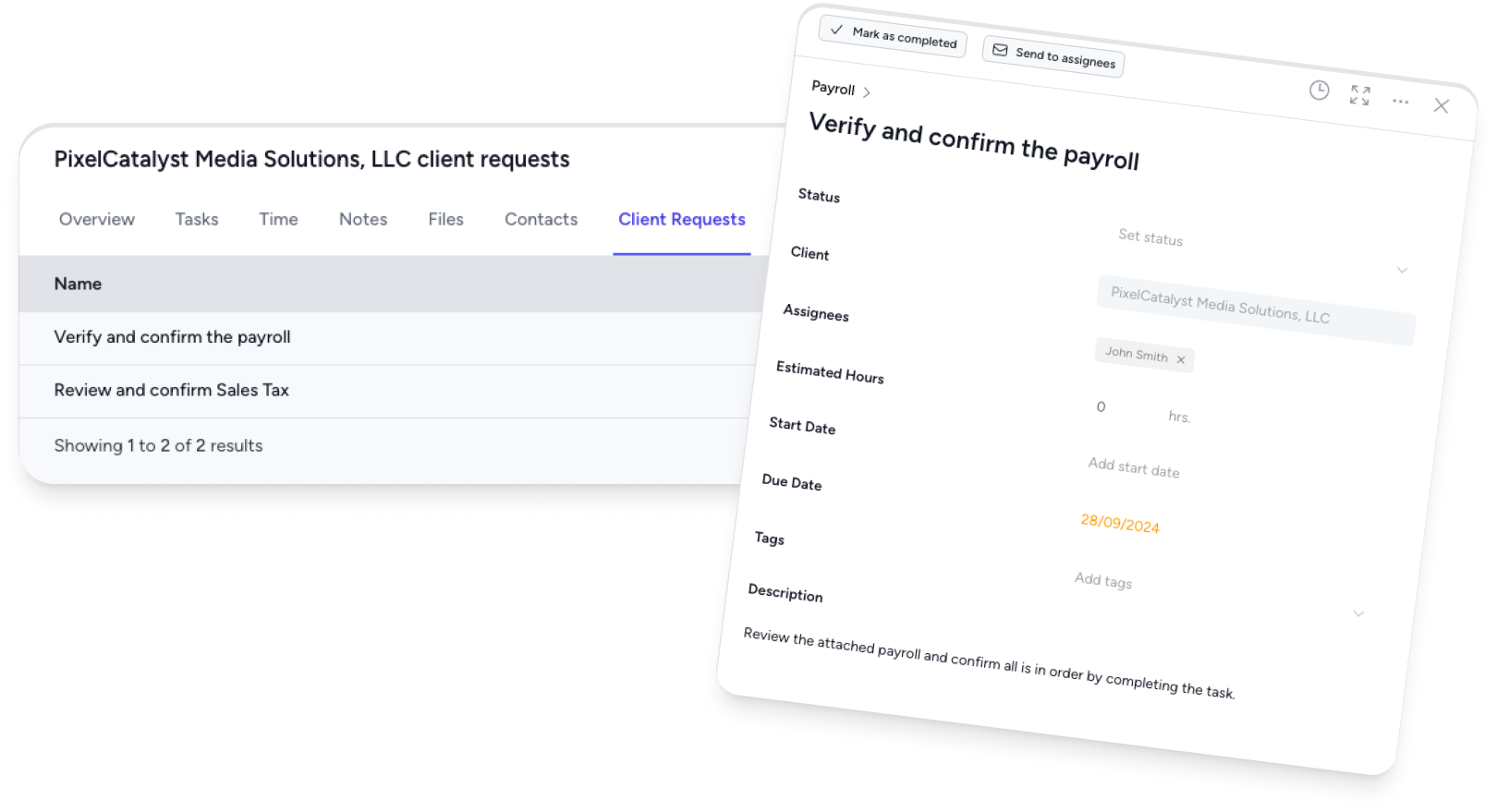
Then put the steps on the job. A template with subtasks, a named owner, and the client request attached is a procedure people meet while they work. A file in a shared drive is one they mean to read. Practice management software helps when it holds the template, the request, and the deadline in one client record.
Client notes belong on the client. Preferences, related entities, and who at the client’s office may send documents should be where the next person looks first, not in your sent mail.
The employee onboarding guide is the test. Hand a new hire the templates and notes and see where they still need you. Every question they ask is a line your plan has not written yet.
Try Tidyflow
Hand off the work without handing off chaos.
Job templates, client requests, and a record of who owns the next step. Watch a 4-minute demo, or start a free trial. No credit card required.
Keep client trust while you step back
Clients of a small firm often experience the firm as a person. You earned that. Succession asks you to spend it.
Make the introduction while you are still glad to be there. A joint call, an email from the firm rather than from you alone, and a first cycle where you review and they deliver is calmer than a letter announcing your retirement and a new name. For the largest clients, one introduction is not enough. They should see the successor on ordinary work, in an ordinary month, before any announcement about ownership.
Give clients a place to send documents that is not your personal address. A portal and a request list mean the relationship survives a change in who clicks send. The new client checklist is written for onboarding, but the same steps (access, scope, and a recurring job) re-anchor a long-time client to the firm.
Tell the truth about what will change. Scope, fee, and who reviews are what clients worry about. If those stay steady through the overlap, say so. If a successor will eventually price the work differently, do not promise permanence you will not be there to keep.
Staff need a matching message: who owns which clients, which decisions remain yours, and how long the overlap lasts. Silence makes people invent a sale.
A timeline you can run without a transaction
Use this as a planning grid, not a promise that every firm needs five years. Shrink it if you must, but do not skip the middle, where someone else actually does the work.
Name the destination. One paragraph: your last working year, what clients should experience, and what you want for the people who stay. “Sell for as much as possible” is not a destination until you have said whether you will stay, for how long, and under whose direction.
Pick the first service line. Not the whole firm. Choose repeating work with enough volume to practice on. Assign an owner, give them a written review standard, and let them run a full cycle while you are the backstop.
Rank clients. Fee, service, who they call, and whether a second person has met them. Start introductions at the top. The sale-readiness checklist has the fuller version of that page, and it is worth using even if you intend to keep the firm.
Put the agreement on a date. Partners should review retirement, disability, and pricing terms while nobody is using them. A solo owner should ask counsel what happens if they cannot work.
Prove a break. Two weeks when you are not the hidden reviewer. Fix whatever stopped. A firm that cannot survive a planned absence cannot survive a retirement.
Then decide the ownership step. Internal buyer, a slower step-down, a smaller firm, or an outside successor. A year of evidence beats a mood in April. Revisit the destination paragraph yearly, and keep the jobs, introductions, and agreement dates on the calendar the firm already uses.
What to leave to advisers
Keep for yourself the calls that depend on people you know: who is ready to lead, which clients need a personal introduction, which work stays under owner review, and whether you want to keep working.
Hand the rest to advisers: how equity is valued and transferred, how payments are taxed, what a client-protection clause may say in your state, licensing if a successor firm is different from yours, and any continuation arrangement. A lawyer and a tax adviser can see your agreement. This page cannot.
Frequently asked questions
What is accounting firm succession planning?
It is the plan for who leads the firm, who owns the client relationships, and who holds the equity when the current owners step back. Those are three handoffs. A firm can transfer leadership without selling, and it can sell without having developed a next leader. Control means you choose the order and the timing while you still can.
When should an accounting firm start succession planning?
Start while the owner still wants to work and can still introduce a successor. A leadership handoff often takes several seasons of shared clients, not a single announcement. If you want an internal owner, begin early enough that the person can learn review, pricing, and client trust before your date.
What if the firm has no internal buyer?
Then succession is a transition to someone outside the current ownership, on a timeline you still set. Prepare the firm so the work is documented and clients know more than one person. An outside sale or a merger is one possible result. It is not a substitute for deciding who does the work between now and then.
How do we hand off clients without losing them?
Introduce the next person while you are still the trusted owner, put them on the recurring work, and give clients a firm they can see in the portal and on the job, not only in your inbox. A relationship that has never included anyone else is the one most likely to wobble when you leave.
Is succession planning the same as selling the practice?
No. Selling is one way ownership can change. Succession planning also covers who manages, who reviews, and who clients call if you stay, slow down, or never sell. Get the firm runnable first. Price, if you need it, comes after the work is explainable.
Retire from the front of the work first
Choose one service line this month. Name the person who will own it, write the review exceptions, and introduce them to the clients who currently call only you. Put the steps on a job template so the handoff is visible on Monday morning, not in a document you hope someone reads.
Ownership paperwork and any later conversation about price sit on top of that. You keep the timeline by doing the handoff while you are still the person clients trust enough to share.