Selling an accounting practice goes better when the practice can run without you in every file. Buyers, partners, and staff successors all ask the same question: if you stepped back, would the recurring work, the deadlines, and the client relationships continue?
This checklist is for owners of CPA, bookkeeping, and tax practices who want that answer to be yes before they talk about price, retirement, or a handoff. It covers control, documentation, recurring jobs, client concentration, and key-person risk. It is not a guide to listing a firm, and it does not assume you have decided to sell. If you are on the other side of the table, buying a book of clients, the buyer’s section near the end is for you.
For the price conversation, read how buyers set an accounting practice valuation. For the timeline, read accounting firm succession planning.
What sale-readiness actually means
A practice is sale-ready when a competent person who is not you can see three things:
- What work repeats, and what the client has agreed you will do.
- Who does each step, including review, and what “done” looks like.
- Which clients and fees would transfer, and which depend on your personal relationship.
Price comes after that. A clean set of jobs will not name your price, but a practice where only you know how each client likes questions answered is hard to explain to anyone. The operational work is the part you control, and it pays off even if you only want a longer vacation.
“Practice” here means the book of client work, whether the entity is a firm, a partnership, or a sole proprietorship.
Sale-readiness checklist
You do not need every line finished before you tell a partner you are thinking about the next five years. You do need an honest yes, no, or “only if I am in the office” on each one.
| Area | Sale-ready looks like | Still owner-bound |
|---|---|---|
| Control | You can name who owns each recurring job, and a second person can review it | Status lives in your inbox or your memory |
| Documentation | The repeating steps sit inside the job, short enough for a new hire to follow | ”Ask me” is the procedure |
| Recurring work | Bookkeeping, payroll, estimates, and returns are templated and scoped in writing | Work is recreated from last year’s email |
| Clients | You know fees, services, and who each client actually calls | One spreadsheet, three inboxes, and you |
| Concentration | No single client would scare a successor, or you have a plan for the ones that would | One relationship is a large share of fees |
| Key people | Review, billing, and software access are not one person’s secrets | Passwords, judgments, and client trust sit with you |
| Money | Fees, scope, and unpaid invoices can be explained without a reconstruction | You would need a month to answer “what did we bill?” |
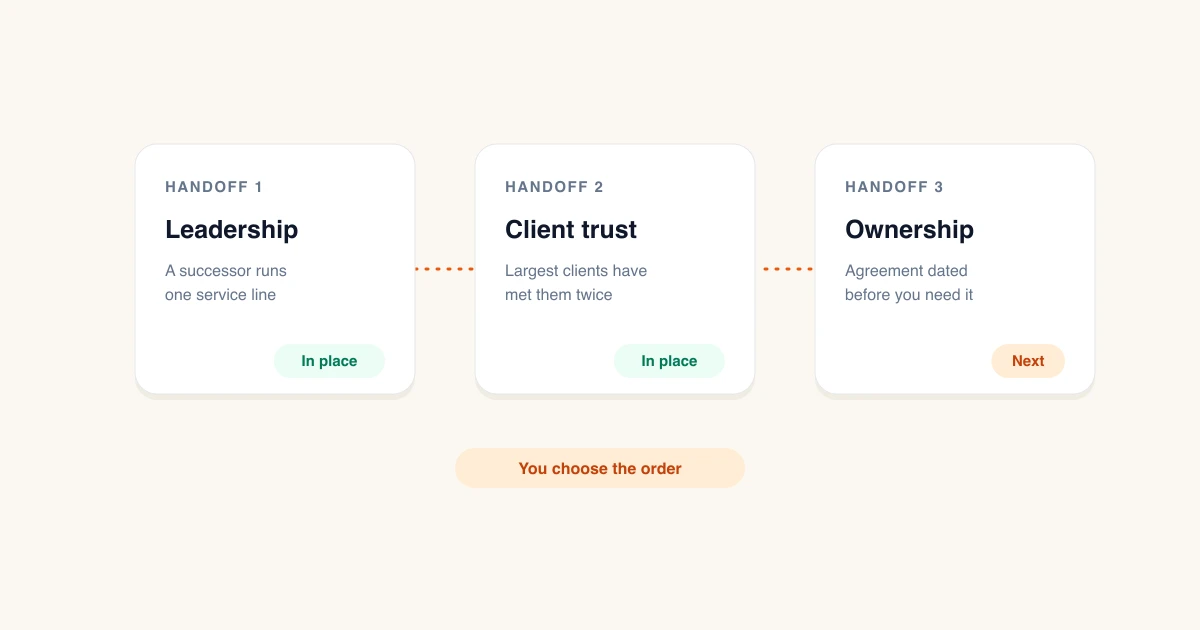
| Handoff | Clients have already met the person who would keep their work | Every introduction would start the day you leave |
The rest of this guide is how to move a row from the right column to the left.
Take the owner out of the middle
Owner-dependence is the gap between “the practice knows how to do this” and “I know how to do this.” It shows up in ordinary weeks:
- Clients email you, even when someone else does the work.
- Review means you, including returns a senior could sign.
- Pricing, write-offs, and exceptions happen in conversations nobody writes down.
- Prior-year notes and client quirks are in your head or on your desktop.
- A week off means a pile, not a practice that moved.
That is how most small practices get built. A successor experiences it as risk. If clients are loyal to you rather than the firm, keeping them takes a longer handoff, and more of what you receive usually depends on whether they stay. Introduce other people now, while clients still trust you enough to accept the introduction.
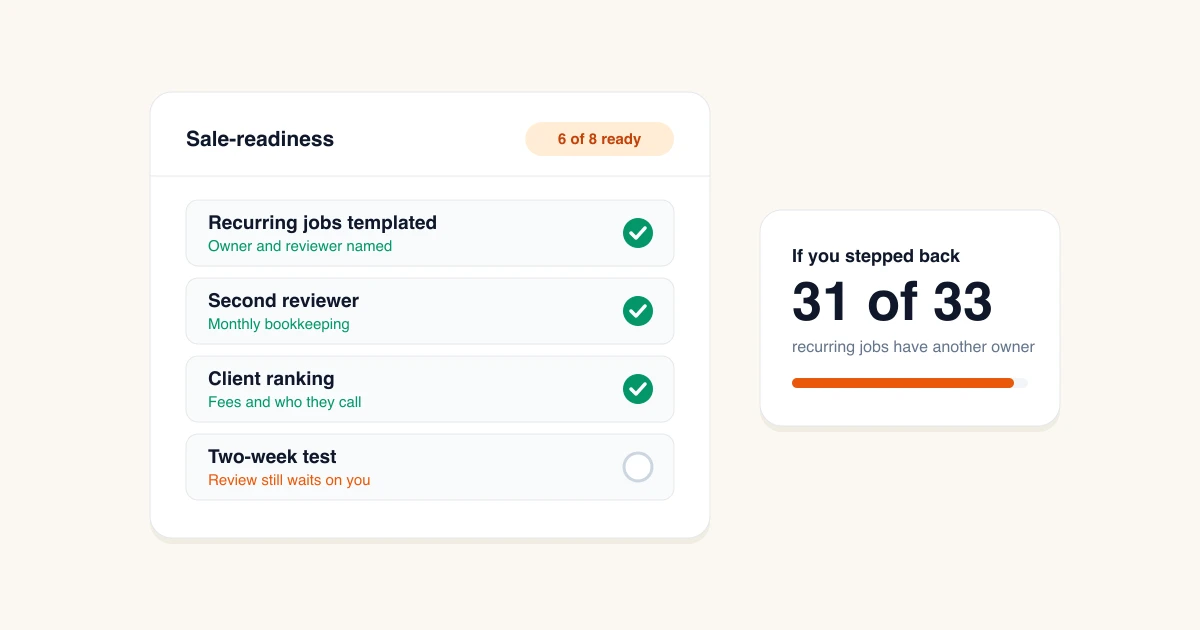
Run a two-week test
Pick a quiet stretch, or invent one on paper. For every job that would move in those two weeks, write the name of the person who would do it if you were unreachable. Leave the line blank when the answer is you.
The blanks are your checklist. They usually cluster in review, client calls, and oddball clients. Clear the ones that repeat.
Give review a second name
Choose one service line, often monthly bookkeeping or individual returns, and name a reviewer who is not you for a defined slice of it. Write the exceptions that still come to you: a new client, a client who has asked for you, a variance you define. “Use your judgment” is not an exception list. “Bring me variances over 20% from last year” is.
If every review hour is already yours, sale-readiness is a workload problem before it is a paperwork problem. The capacity planning guide covers that.
Document the work people repeat
Buyers do not want your history. They want the path from “client sent the documents” to “work delivered and billed” for the jobs you do every month and every season:
- Monthly or quarterly bookkeeping, through the reports you actually send
- Tax preparation, including what you need from the client and who reviews before filing
- Payroll and sales tax, if in scope
- Estimates, extensions, and the other seasonal jobs that are easy to drop
- Onboarding, from signed engagement letter to the first recurring job
- Billing, including who can write off time or delay an invoice
Skip one-off projects and anything your software vendor already teaches. “Reconcile the operating account in QuickBooks Online, then tick the step” is a useful step. Reteaching reconciliation is not.
The process documentation guide has a short SOP shape with examples for bookkeeping, tax preparation, and onboarding. Keep each procedure to the steps a competent hire would not guess, including the branches: a broken bank feed, a missing document, a number far from last year.
Put the procedure on the job
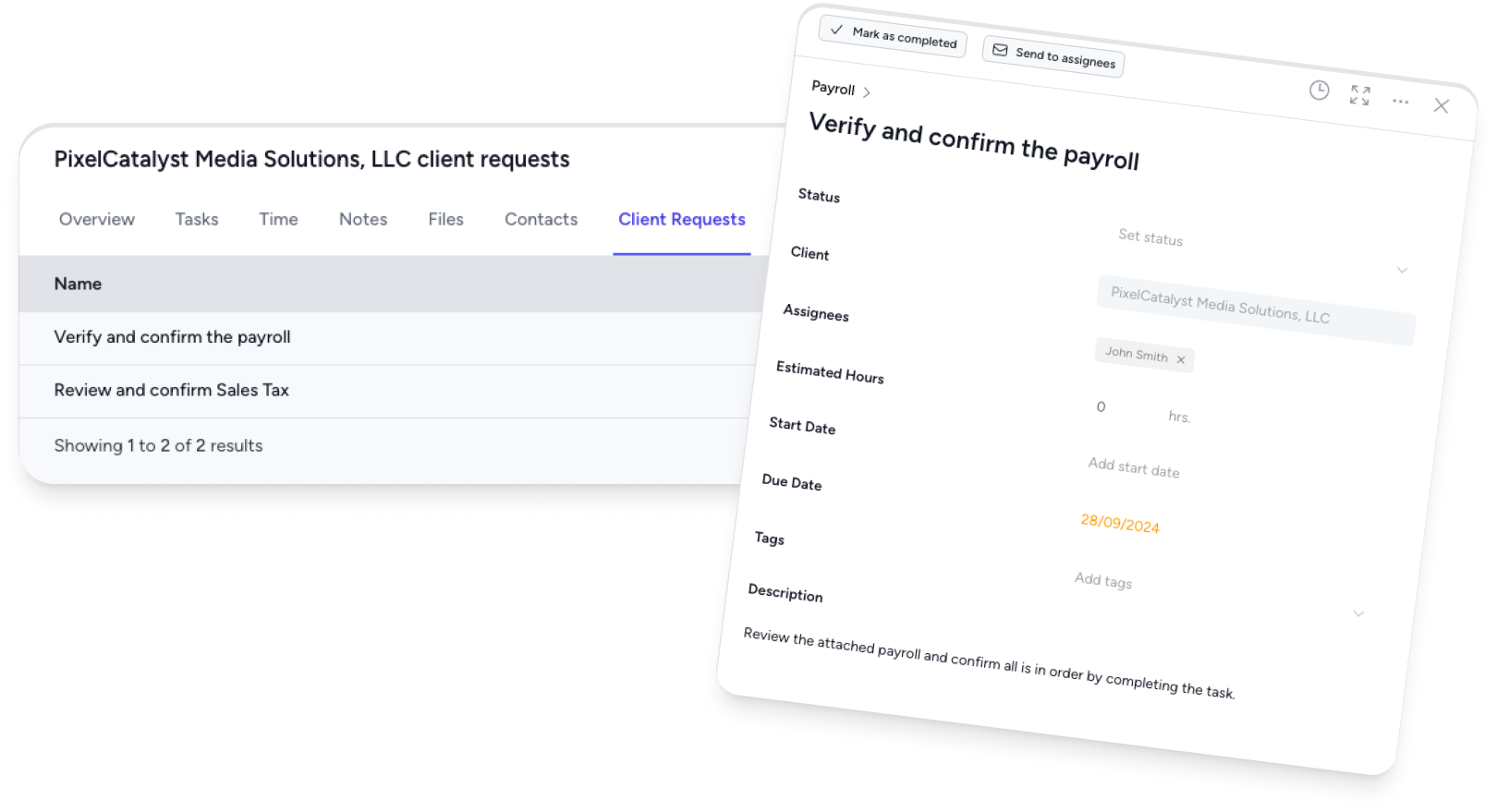
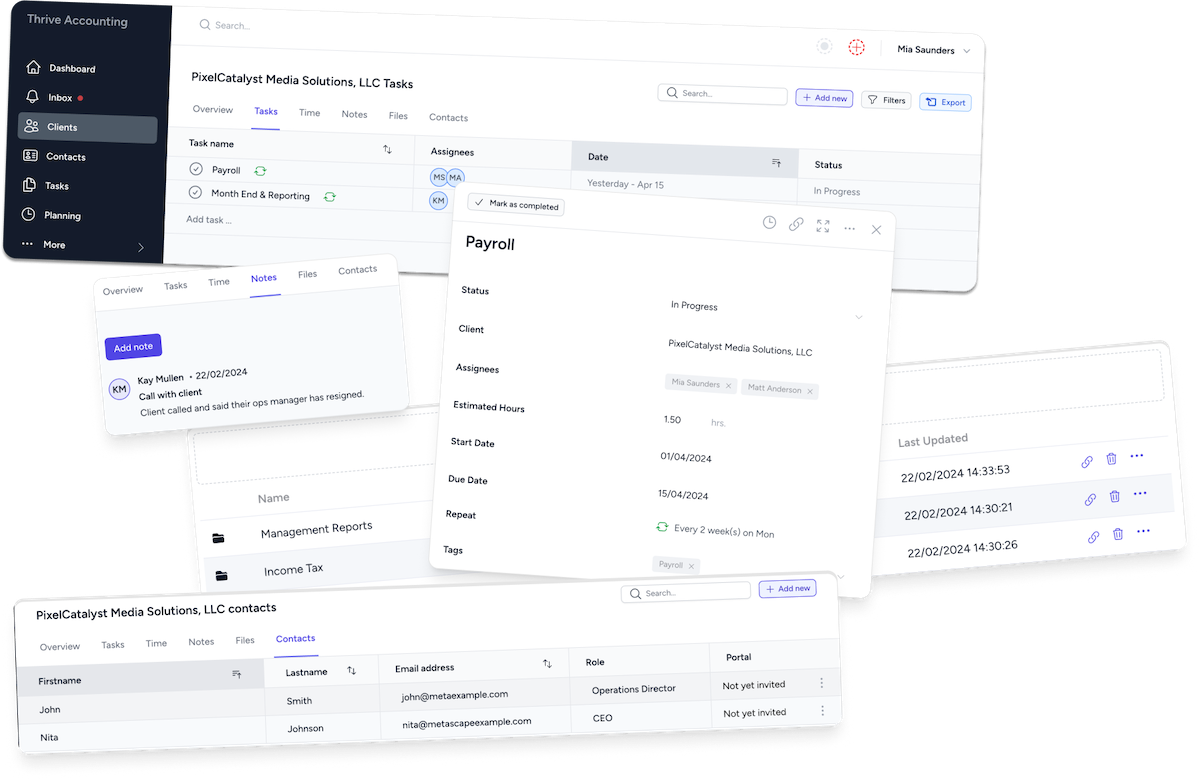
A document in a shared drive helps. A checklist on the job helps more, because the person doing the work is already there. Turn the repeating steps into subtasks on a job template: request the statements, reconcile, review, deliver, bill. When next month is created from that template, the procedure shows up without anyone remembering to open a file.
That is what “systems” means in practice. Practice management software is where those templates, client requests, and deadlines live together. The tool matters less than the habit. If the work is still a copy of last year’s folder, the system is you.
Try Tidyflow
Make the recurring work runnable without you.
Turn the jobs you repeat into templates your team can follow. Watch a 4-minute demo, or start a free trial. No credit card required.
Make recurring revenue visible
Split the practice into work that has a next occurrence and work that does not.
Repeating work includes monthly bookkeeping, payroll, sales tax, CAS or controller retainers, quarterly estimates, and annual returns for clients you expect back. A successor can staff it, price it, and see it on a calendar.
One-time work includes cleanups, special projects, and the return for someone who wandered in during March. It can be good work. It is a weaker promise about next year.
For each repeating service, keep four facts in one place:
- The client and the entities you serve
- The fee and how often it bills
- The scope, in an engagement letter or current proposal, not a memory of what you threw in
- The job template that creates the next occurrence, with an owner who is not automatically you
If scope and fee have drifted apart, fix that before you describe the practice to anyone. A bookkeeping client who still gets extra schedules “because we always have” is not a clean recurring fee. The new client checklist is a useful reset, even for clients you have had for years, and productizing the services you already sell is the same project from the pricing side.
Look at client concentration and mix
A successor is not buying your affection for the client list. They are asking whether the fees survive a change of face. Build one page from the last twelve months of billings:
| What to list | Why it matters |
|---|---|
| Fee by client, largest first | Shows whether one relationship dominates |
| Services for that client | A tax-only client transfers differently from a monthly bookkeeping client |
| Who the client calls | You, a named staff member, or “whoever answers” |
| Years as a client | Long tenure helps, and can also mean the relationship is personal |
| Written scope and current fee | Gaps here become arguments later |
| Open issues | Late books, unpaid invoices, a dispute, a promise made verbally |
There is no universal “too concentrated” percentage. Use a practical test: if losing the largest client would change whether you could pay the team, that client needs a plan. Another person who knows the work, a written scope, and a clear note that a successor will treat the relationship as a risk. A list topped by modest monthly clients with templates and a second contact is in better shape than the same total fees spread across three heroic relationships.
Note work a general successor may not want, such as litigation support, a heavy cleanup book, or fees that depend on a license only you hold. Note the age of the client base too. Owners retiring alongside you are a different promise from operating businesses with monthly work.
Reduce key-person risk without a reorganization
Key-person risk is owner-dependence plus anyone else the practice cannot lose. In a two- or three-person shop, that may be everyone. You need no single absence to hide the work:
- Access. Who can open the tax software, the ledgers, the portal, and payroll? A firm-owned password manager with a second administrator beats a personal vault.
- Review. If you are out, what still gets filed, delivered, or billed?
- Client trust. For the largest clients, has anyone besides you been on a call this year?
- Staff knowledge. If your strongest preparer or bookkeeper left, which jobs would stall?
- Notes. Preferences and entity quirks live somewhere other than your memory.
The employee onboarding guide is the same test from the other direction. If a new person cannot see where a job stands without asking you, the practice is not ready to change hands.
Get the practice’s own numbers explainable
This is not a formal valuation. It is being able to answer ordinary questions without rebuilding the year from invoices.
Pull the last two or three years, by service line if you can: fees billed and collected, a labeled split of recurring and one-time work, receivables you will not collect, unbilled work, owner pay and personal expenses that run through the practice, and the rent, software, and staff costs a successor would recognize.
Accounting firm KPIs such as realization and collection describe the practice you have. If you have never tracked them, start with fees, collections, and a client ranking. How a buyer turns those facts into a price is covered in accounting practice valuation.
Plan the handoff while you still run the place
Staff. Tell the people who would carry the work what a good handoff means: clients kept, jobs not dropped, no surprise about who reviews. You do not owe them a sale announcement you have not decided to make. You do owe them a practice that is not trapped in one person.
Clients. Introduce the person who will own the relationship while you are still in the room. A portal, a shared inbox, and jobs with a visible status make the firm feel like a firm. An email address that is only your name does the opposite.
You. Write down what you want afterward: a clean departure, a season of introductions, a part-time review role, or no sale at all. Succession planning turns that choice into a timeline.
If you later talk with an attorney or another firm, you will be describing a practice you can already explain. Price and payout belong with a valuator and your own advisers once the work is legible. Many owners who finish the list keep the practice, with a clearer path for whoever eventually carries it.
If you are the one buying
Growing firms buy books of clients too, often from an owner who did none of the work above. The checklist still applies. You are just reading it from the other side.
Before you agree a price, ask for the pages a sale-ready seller would already have: fees by client, written scope, who each client calls, which work repeats, and what is unpaid. Where a page does not exist, that gap is risk you are taking on. Price it, or build it into the retention terms.
In the first season, the work is moving clients from the seller’s habits to your firm’s:
- Put every recurring client on your job templates before their next deadline, not after the first one slips.
- Move document requests off the seller’s inbox and onto your client portal, with the seller’s introduction attached.
- Name the person on your team who owns each inherited client, and have them on the first conversation.
- Keep the seller visible on the largest relationships for as long as the agreement allows.
When the price depends on how many clients are still there in a year or two, every client who meets your team, sends documents through your portal, and gets their work on time is protecting what you paid.
A twelve-month preparation timeline
Owners who feel behind often try to document everything in a month and then stop. A year is enough to change how the practice runs, if you pick a sequence.
Months 1 to 3. See it. Rank clients by fees and mark who they call. List every recurring job and whether a template exists. Run the two-week test. Pull two years of fees, collections, and receivables into one place.
Months 4 to 6. Write the core path. Document monthly bookkeeping or your highest-volume tax workflow first; the month-end close checklist is a start when bookkeeping is the volume. Turn it into a job template with an owner and a reviewer. Put renewed work on a written scope. Name a second administrator for every system the firm cannot afford to be locked out of.
Months 7 to 9. Move relationships. For the largest clients, put a second person on the work and on at least one conversation. Move document requests out of your personal inbox onto a list the team can see.
Months 10 to 12. Prove it. Take a real break, or hand review of one service line to someone else for a full cycle. Fix the template where the work stalled. Reread the checklist table, and wherever the answer is still “only if I am in the office,” decide whether that matches the role you want next year.
Then stop adding projects. Five living templates and a client list you can explain beat a half-finished manual.
Frequently asked questions
What should be on a checklist for selling an accounting practice?
Cover owner-dependence, written procedures, recurring jobs with a named owner, client concentration, staff who can keep the work moving, and a clean picture of fees, scope, and receivables. Sale-readiness is the state of the practice, not a listing.
How early should I start preparing an accounting practice for sale?
Start while you still want to keep working. A year is a practical minimum for documentation, a second reviewer, and cleaner recurring work. Three to five years is more realistic if you also need an internal successor or a partner who can carry client relationships.
Why does owner-dependence lower the appeal of a practice?
Buyers and internal successors are taking on work that has to continue after you step back. If clients call only you, you are the only reviewer, and the real process lives in your head, the revenue is riskier. Reducing that dependence is part of getting sale-ready, whether or not a sale happens.
Do I have to document every process before I sell?
No. Document the recurring work that produces most of the fees, plus onboarding, review, and billing. Skip one-off tasks and steps your software vendor already explains. A short procedure inside the job is more useful than a binder nobody opens.
What should a buyer check before taking on an accounting practice?
Ask for the same pages a sale-ready seller keeps: fees by client, written scope, who each client calls, which work repeats, and what is unpaid. Then plan the first season. When the price depends on retention, getting every recurring client onto your jobs, requests, and portal quickly protects what you paid.
Does getting sale-ready mean I have to sell?
No. The same work makes the practice easier to run, easier to hand to a partner, and easier to step back from for a season. Selling is one use of that preparation. Keeping control of the timing is the point.
Start with the work, not an announcement
Pick the recurring service that produces the most fees. Write the steps, name an owner who is not only you, and create the next job from a template. Then rank your clients and mark who they call.
Once those two pages exist, a conversation about price or succession starts from facts. Until then, a price is a guess sitting on top of a practice only you can see.