Try Tidyflow
Get your firm organized.
Watch a 4-minute demo, or start a free trial. No credit card required.
No — AI will not replace accountants. It will replace specific tasks inside accounting jobs: data entry, transaction categorization, document processing, and first drafts of routine writing. The judgment, liability, and client relationships that define the profession stay human. But the shape of the work is changing, and firms that ignore that will lose ground to firms that don’t.
This article answers the question properly: what actually automates, what doesn’t, what it means for bookkeepers and tax preparers specifically, and what your firm should change now. For the hands-on side — how to actually put AI to work in a firm — see our practical guide to AI for accounting firms.
Will accounting be replaced by AI?
No. The mistake in most “AI will take over accounting” predictions is treating accounting as one job. It isn’t — it’s a bundle of tasks, and those tasks have very different exposure to automation.
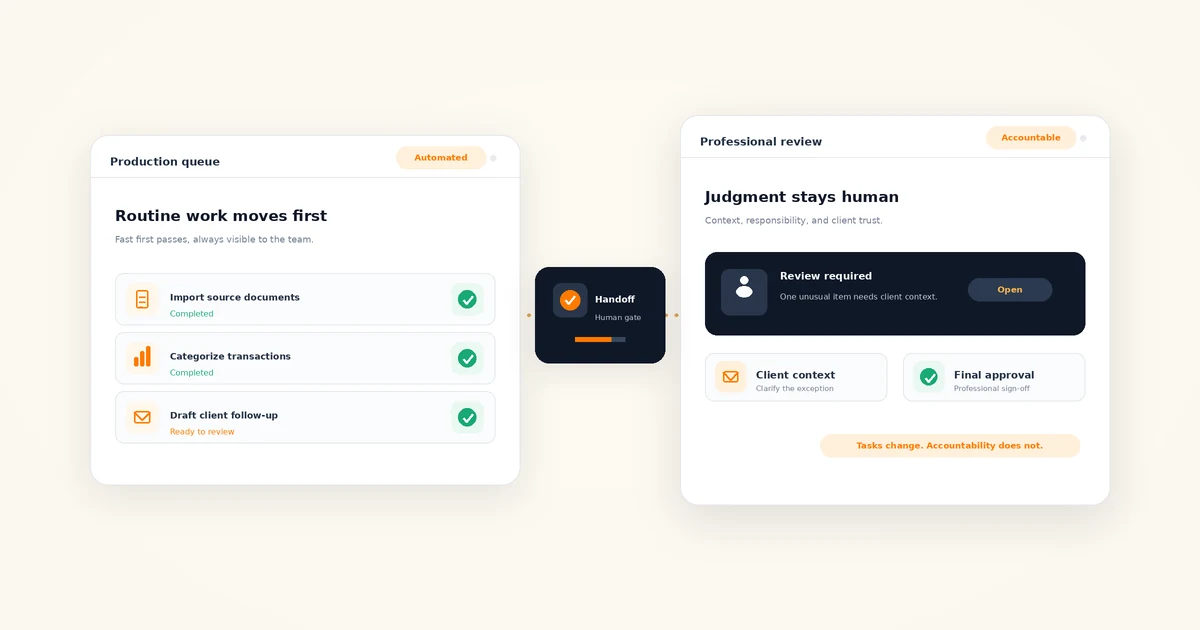
Think of any engagement your firm runs. Some of the work is production: keying data, coding transactions, matching payments, assembling documents, writing routine emails. Some of it is judgment: deciding how a rule applies to a messy set of facts, spotting what a client didn’t tell you, choosing what to recommend. And some of it is accountability: signing the return, standing behind the numbers, being the person the client calls when something goes wrong.
AI is genuinely good at the production layer. It has no path to the judgment and accountability layers, because those aren’t information-processing problems — they’re responsibility problems. A model can’t hold a license, can’t be sued, and can’t sit across from a client whose business is in trouble.
So the honest answer to “will accounting be replaced by AI” is: the production layer of accounting is being replaced, and it’s happening now. The profession is not.
Which accounting tasks will AI automate first?
Task exposure follows a simple pattern: the more repetitive, high-volume, and pattern-based the work — and the easier it is for a human to check — the faster it automates.
| Task | Automation exposure | Why |
|---|---|---|
| Manual data entry from documents | Already automating | OCR and extraction tools read invoices, receipts, and statements reliably |
| Transaction categorization | Already automating | Repetitive, high-volume, pattern-based — the ideal machine-learning problem |
| Bank reconciliation matching | Already automating | Rule-following work with clear right answers |
| First drafts of routine client emails | Already automating | Low risk, fast to review, immediate time savings |
| Document collection follow-ups | Automating now | Structured chasing that AI can draft and schedule |
| Meeting notes and internal summaries | Automating now | Transcription plus summarization is mature technology |
| Tax and regulatory research prep | Partially | AI accelerates gathering, but a professional must verify every source |
| Financial commentary first drafts | Partially | Useful starting points, but numbers and framing need review |
| Final review and sign-off | Not automating | Requires licensed professional responsibility |
| Advisory and planning conversations | Not automating | Requires judgment, trust, and knowledge of the client |
Notice what the top of the table has in common: it’s the work nobody went into accounting to do. The tasks automating first are the ones firms already struggle to staff, already do at thin margins, and already treat as a cost of doing business. The newer wave of AI agents for accounting firms extends this from single tasks to short chains of tasks — drafting the follow-up, not just the sentence — but the pattern holds: production automates, judgment doesn’t.
Is accounting safe from AI?
The profession is safe. Specific task lists are not. Four things protect accounting as a career, and none of them are going away:
Judgment. AI can recite a rule. It can’t reliably apply the rule to a specific client whose facts are incomplete, contradictory, or unusual — which describes most real client situations. Knowing which questions to ask, which answers to distrust, and when the textbook treatment is wrong for this client is the actual skill, and it’s built on experience AI doesn’t have.
Liability. Someone has to be accountable for the work. Regulators license people, not models. When a return is wrong, a covenant is breached, or an audit fails, there is a professional whose name is on it. No firm, insurer, or regulator accepts “the AI did it” — which means a qualified human must review and own every output that matters.
Relationships. Clients don’t buy tax returns; they buy the confidence that someone competent is watching their financial position. That trust is built through conversations, responsiveness, and years of context. AI can free up time for those relationships. It can’t have them.
Regulation. Professional standards, verification duties, independence rules, and quality-control requirements are all built around human responsibility. Regulatory frameworks move slowly and conservatively — deliberately so. The compliance perimeter around accounting work is a structural barrier to full automation, not a temporary one.
Will AI replace bookkeepers?
Bookkeeping is the most exposed corner of the profession at the task level — and it’s still not a story of replacement.
The manual core of bookkeeping — keying transactions, coding them, matching payments — is exactly the repetitive, pattern-based work AI handles best, and accounting software has been automating it for years. That trend continues, and AI accelerates it.
What that changes is the shape of the role, not its existence. Automated categorization is good, not perfect — and “good, not perfect” in bookkeeping is a problem, because books need to be right. Someone has to review the machine’s output, catch the miscoded transactions, handle the exceptions, chase the missing information, and talk to the client. That’s supervised accuracy work, and it’s what bookkeeping becomes.
The practical verdict: bookkeepers whose value is typing speed are exposed. Bookkeepers whose value is clean, trustworthy books — with automation doing the typing — are not.
Will AI replace tax preparers?
The split here is between simple and complex returns, and it predates AI.
Simple returns — one employer, standard deduction, no complications — were being commoditized by consumer tax software long before generative AI arrived. AI continues that squeeze. If a firm’s model is high volumes of simple returns priced on effort, that model is under pressure regardless of what AI does next.
Complex work is a different story. Multi-entity structures, planning decisions, unusual transactions, and anything requiring representation before a tax authority all depend on judgment, current-law verification, and credentialed humans. AI is genuinely useful inside that work — organizing research, drafting client explanations, preparing checklists — but it’s an accelerant for the preparer, not a substitute. AI also has a known weakness that matters enormously in tax: it can be confidently wrong about specific rules, thresholds, and dates, which is precisely what tax work cannot tolerate without verification.
Will AI replace accountants by 2030?
Almost certainly not — and be suspicious of anyone quoting a precise percentage of accounting jobs that will disappear by a specific year. Those forecasts have a poor track record, and the honest answer is that nobody knows the numbers.
What you can reasonably expect by 2030, arguing from the task structure rather than predictions:
- Routine production work becomes AI-first by default. Drafting, categorization, extraction, and summarization done by AI and reviewed by humans will be the normal way firms work, the way cloud accounting software became normal.
- Clients will assume it. Pricing pressure lands on anything that looks like routine production, because clients will know it no longer takes the hours it used to.
- Roles shift toward review and advisory. Junior roles built on production work get redesigned around checking, exceptions, and client contact — which raises real questions about how firms train juniors, since production work was the traditional training ground.
- Accountability stays human. Licensing and liability aren’t on a path to change by 2030.
One more piece of context most replacement headlines skip: many firms can’t hire enough qualified staff as it is. When a profession has more work than people, automation tends to absorb the unmet demand before it eliminates the jobs. That doesn’t make anyone immune — but it means the realistic 2030 risk for an accountant is not being replaced by AI. It’s being outcompeted by an accountant who uses it.
What should your firm change now?
Not much of this requires budget. It requires deliberateness.
- Move routine drafting to AI this month. Client emails, document requests, SOP drafts, meeting summaries — low risk, immediately reviewable, real time savings. Our ChatGPT prompts for accountants library is a ready starting point.
- Put an AI policy in place before adoption spreads. Your team is likely already using these tools quietly, with no rules. The non-negotiables: never paste client-identifiable or confidential information (names, tax IDs, bank details, payroll data, unredacted financial statements) into a public AI tool; anonymize inputs; use only firm-approved tools with appropriate privacy controls; and have a qualified professional verify every financial, tax, regulatory, and client-facing output. Our AI policy template for accounting firms gives you a copy-paste starting point.
- Reprice work that’s drifting toward automation. If routine deliverables take half the hours they used to, hourly billing hands the entire gain to the client. Move routine work toward fixed pricing and let efficiency improve your margin.
- Redesign roles around review, not production. The valuable skill shifts from doing routine work to judging AI-produced work quickly and catching what’s wrong. Train for that explicitly — especially with juniors, who no longer learn the fundamentals through volume by default.
- Get your firm’s work into a structured system. AI can only act on work it can see. If jobs, deadlines, and client requests live in inboxes and spreadsheets, there’s nothing for automation to attach to. This is where practice management fits — in Tidyflow (our product), for example, every job, deadline, and client request is structured and trackable, which is the foundation that automation, including AI agent teammates, builds on.
- Reinvest the saved time in advisory. The durable, unautomatable value in accounting is judgment applied to a client you know well. Every hour AI saves on production is an hour that should move toward the work clients actually value most.
Frequently asked questions
Will AI take over accounting jobs?
AI takes over tasks faster than jobs. Roles built almost entirely on manual data entry shrink first, while roles involving review, client contact, and judgment absorb the freed-up time. And because many firms struggle to hire enough staff, automation tends to absorb unmet capacity before it cuts existing positions.
Can AI replace accountants?
Not fully. AI can produce drafts, categorize transactions, extract data, and summarize information — but it can’t be licensed, can’t carry liability for a filing, and can’t exercise professional judgment on incomplete real-world facts. Every AI output in accounting still needs a qualified professional to verify it and take responsibility for it.
Is accounting a good career if AI is coming?
Yes — arguably better than before, with a caveat. AI is removing the tedious production work from the profession while leaving the judgment, advisory, and relationship work that pays best. The caveat: the career rewards people who learn to supervise AI-assisted work early, and it will be harder on anyone whose only offer is manual production.
The bottom line
Will AI replace accountants? No. It replaces tasks — the repetitive production layer that accountants never wanted to spend their time on anyway. Judgment, liability, relationships, and regulation keep the profession human.
But “AI won’t replace you” is not the same as “nothing changes.” The work is being repriced, roles are being reshaped around review and advisory, and clients will soon assume every firm works this way. The real dividing line over the next few years isn’t accountants versus AI. It’s firms that adopted it deliberately — with a policy, a workflow, and a repricing plan — versus firms that waited.
Start with one task this week. The rest follows from there.